
TRUE COST
The Short Version
True Cost is what your machine expects a possible future to cost, after accounting for everything it anticipates gaining, losing, avoiding, or having to deal with. It's not just money, effort, or unpleasantness. Rewards, opportunities, pleasure, relief, and freedom can make an otherwise difficult future worth choosing. And because every machine has different priorities, memories, and expectations, the same future can be cheap for one person and ridiculously expensive for another. The machine chooses the available future with the lowest projected True Cost. Not necessarily the future you consciously want, or the one that turns out best. The one your machine expects to be most affordable.
What Would That Future Cost You?
Imagine being offered a promotion. More money, a better title, new opportunities, and a chance to do something you've wanted for years. You like the company, you know the work, and everyone assumes you'll take it.
Except you don't.
Your coworkers are baffled. Your family thinks you're making a mistake. Someone points out that you've complained about being underpaid for three years, which is true and not particularly helpful.
But the promotion also means longer hours, managing people you currently enjoy working with, more responsibility, less freedom, and a commute that could consume a perfectly respectable portion of your remaining lifespan.
You can want the promotion and still not choose it.
To understand why, we need to look at True Cost.
What Is True Cost?
True Cost is the net anticipated burden of a possible future, as evaluated by the machine that would have to live in it.
Every future contains consequences. Some are attractive, some are expensive, and many are both. The machine anticipates what it might gain, what it might lose, what it would have to do, what it could avoid, and what might happen afterward.
True Cost is our name for the resulting evaluation.
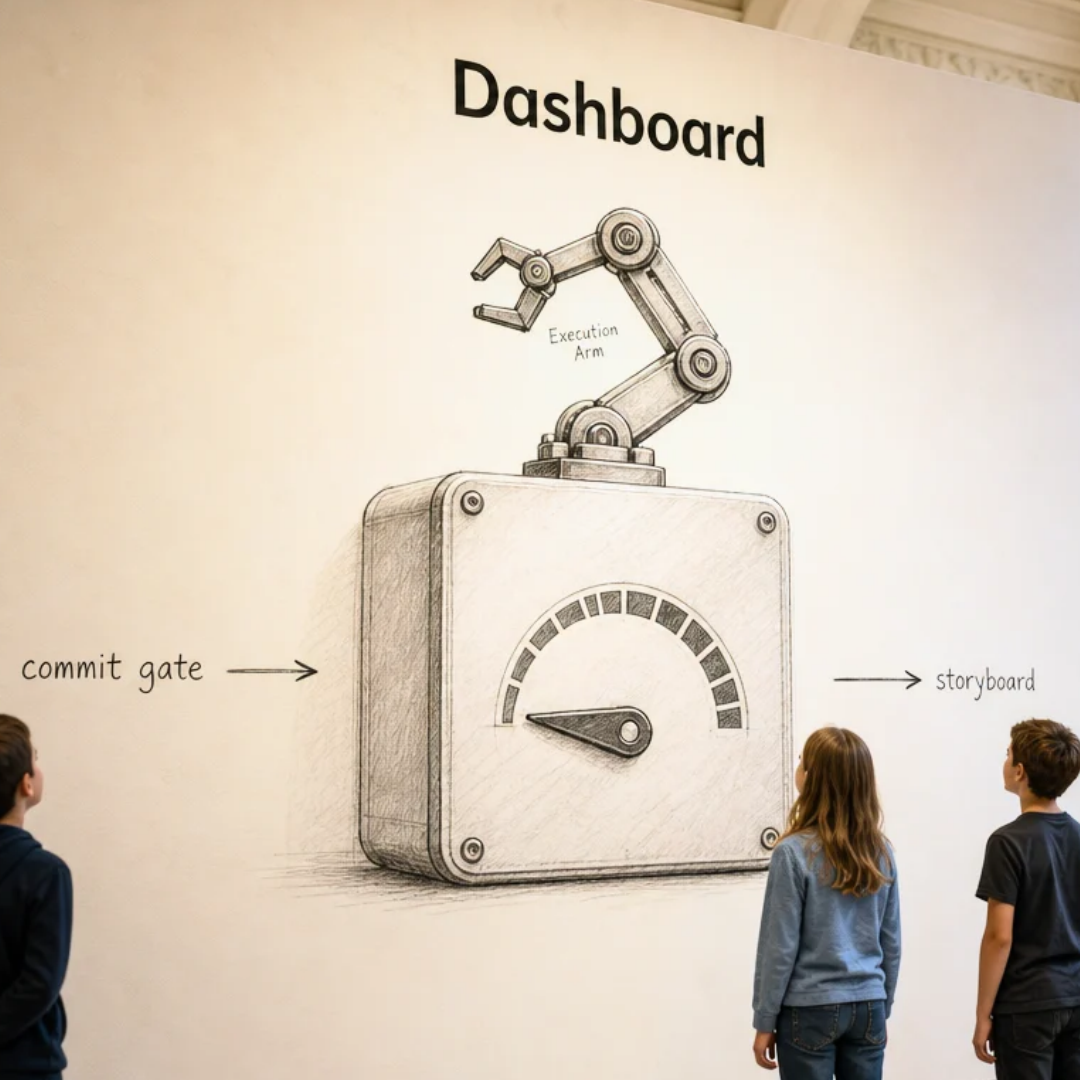
It isn't a separate component of the Overreaction Machine. The Forecast Chamber develops possible futures and their anticipated consequences, and the Commit Gate compares those futures through True Cost.
The central MindStretched claim is simple:
The machine chooses the available future with the lowest projected True Cost.
That doesn't mean it chooses the easiest future, the safest future, or even the one that will eventually make the person happiest. It means the machine selects the future that currently appears to carry the lowest overall burden, after accounting for its anticipated benefits as well as its costs.
WHERE TRUE COST SITS IN THE MACHINE
FORECAST CHAMBER
What could happen next, and what might each future involve?
↓
COMMIT GATE
Which available future has the lowest projected True Cost, and has it gained enough advantage for the machine to commit?
↓
DASHBOARD
Carry out the committed trajectory under the machine's current conditions.
True Cost isn't another component sitting between the Forecast Chamber and Commit Gate. It's the valuation principle the Gate uses to compare possible futures. The Gate also has a Commitment Threshold, which determines how much advantage one future needs before the machine commits.
Once the Gate closes, the selected trajectory proceeds to the Dashboard for execution.
THE COST INCLUDES WHAT YOU GET
The word cost makes people think of something unpleasant. Money spent, work required, time lost, pain endured.
Those things count. But they aren't the whole calculation.
Suppose you decide to train for a marathon. The projected future includes early mornings, physical discomfort, hours of running, rearranged schedules, and possibly a very unpleasant encounter with mile twenty-two.
It may also include satisfaction, achievement, excitement, improved fitness, time with friends, and the pleasure of doing something you previously couldn't do.
Those attractive consequences matter.
A future can require considerable effort and still have a low True Cost because the machine anticipates getting something valuable in return.
The reverse is also possible. A future that looks easy from the outside may be extremely expensive to the machine evaluating it.
Doing nothing, for example, might require no physical effort at all while carrying enormous anticipated costs in regret, missed opportunity, dependence, or continued frustration.
True Cost isn't how hard a future looks. It's how the whole future evaluates to the machine.
THERE IS NO UNIVERSAL PRICE LIST
Consider moving across the country for a better job.
For one person, the move offers independence, novelty, opportunity, and the chance to escape a routine they've grown tired of. Packing up the house is inconvenient, but the future looks attractive.
For another, the same move means leaving family, losing familiar surroundings, disrupting relationships, rebuilding a social life, and surrendering a routine that works perfectly well.
Same destination. Same salary. Same moving expenses.
Completely different True Costs.
The difference isn't necessarily intelligence, courage, maturity, or willingness to take risks. The two machines are evaluating different anticipated consequences, or assigning different importance to the same ones.
Their Pancake Stacks may establish different priorities. Their memories may supply different expectations. Their bodies may be operating under different conditions. Their Master Divides may make autonomy, predictability, identity, or other concerns particularly consequential.
There isn't one correct price attached to moving across the country.
The price depends on the machine doing the evaluating.
THE MACHINE CAN GET THE PRICE WRONG
This is one of the most important distinctions in True Cost.
The machine isn't comparing what the available futures will actually cost. It can't. They haven't happened yet.
It's comparing what it projects they will cost.
Someone may anticipate that changing careers will be disastrous, only to discover that the change was surprisingly easy. Someone else may expect a wonderful new relationship and discover an impressive collection of problems they hadn't considered.
The machine can overestimate danger, underestimate effort, exaggerate a reward, or fail to represent a consequence altogether.
It can choose a future that later becomes spectacularly expensive.
That doesn't mean the original choice was based on the actual cost. It was based on the projected one.
We need to keep three things separate:
Projected True Cost: What the machine anticipated before committing.
Actual Consequences: What happened afterward.
Externalized Cost: What other people or systems ended up paying because of the choice.
Those aren't necessarily the same, and the machine doesn't get to inspect next Thursday before making Tuesday's decision.
Reality retains the right to send an invoice.
WANTING SOMETHING ISN'T THE SAME AS CHOOSING IT
People often assume that if someone genuinely wants something, they'll eventually do what it takes to get it.
And if they don't, perhaps they didn't really want it.
But wanting is only part of the machinery.
Imagine someone who repeatedly says, "I want to leave this job."
They mean it. They dislike the work, want something different, and can imagine being much happier elsewhere.
But leaving also brings uncertainty, possible financial instability, interviews, unfamiliar coworkers, disrupted routines, and the possibility that the next job will be worse.
Staying has costs too. Boredom, frustration, missed opportunities, perhaps another year of complaining about the same supervisor.
The machine compares the projected futures as wholes.
It may genuinely value leaving while still assigning it a higher True Cost than staying.
So it stays.
That doesn't prove the desire was fake, or that the person is lazy, weak, or incapable of change.
It means the desired outcome and the selected trajectory are different things.
You don't necessarily choose the future you want most in one respect. You choose the future your machine evaluates as least costly overall.
THE COST OF NOT DOING SOMETHING
Sometimes the arrival of an opportunity changes the price of staying exactly where you are.
Suppose you've been reasonably satisfied with your job. Then another company offers you a position with better pay, more freedom, and work you find interesting.
Suddenly, remaining in your current job includes something it didn't previously seem to include: giving up that opportunity.
Your existing job hasn't changed. Your salary hasn't changed. Your coworkers are still the same people, including the one who microwaves fish.
But now staying means refusing a future that might be better.
The opportunity has created its own anticipated cost of refusal.
This doesn't happen automatically for everyone. One machine may barely register the alternative. Another may spend the next six months thinking about what it turned down.
The important point is that the True Cost of a trajectory depends partly on the alternatives the machine represents.
Doing nothing isn't necessarily free.
Neither is saying no.
TIME AND UNCERTAINTY HAVE PRICES TOO
A future doesn't have to contain an obvious disaster to become expensive.
It may simply require waiting, not knowing, making an irreversible commitment, or giving up something familiar.
Consider two jobs offering similar pay. One is stable and predictable. The other offers greater opportunity but comes with considerable uncertainty.
Some machines find the second future attractive. Others find the uncertainty itself costly.
And the timing matters.
A reward available today may be more attractive than a larger reward years from now. An immediate inconvenience may be easier to avoid than a distant consequence, even when that consequence could be substantial.
But these aren't universal rules. Some machines give enormous weight to distant possibilities. Others are primarily concerned with what happens next.
True Cost includes how the machine represents time, uncertainty, and the consequences of waiting.
THE PANCAKE STACK CHANGES WHAT MATTERS
The Pancake Stack determines which problem the machine is primarily trying to solve. True Cost reflects the valuation of futures under that priority.
Suppose someone is deciding whether to admit they made a mistake.
One possible future involves telling the truth, correcting the error, and accepting whatever consequences follow.
Another involves defending the original position.
If Logic is controlling, inconsistency or weak evidence may make continuing the defense expensive.
If Social is controlling, embarrassment or loss of approval may make admitting the mistake expensive.
If Pattern is controlling, abandoning a familiar explanation may carry substantial cost.
And Survival may be especially concerned with danger or protection.
The other pancakes don't disappear when one takes control. Their concerns can still contribute.
The machine isn't adding four separate bills and picking the smallest. Its current regulatory organization influences the valuation of the whole projected future.
This is one reason the same person can make an evidence-based decision in one situation and defend an astonishingly poor explanation in another.
The facts may be similar. The controlling problem isn't.
THE BODY CAN CHANGE THE PRICE
You can evaluate a future one way in the morning and another way after twelve hours without sleep.
The future itself may not have changed.
But the machine has.
Fatigue can make effort more burdensome. Hunger can increase the attraction of food. Pain can make a familiar activity difficult to contemplate. Elevated activation can alter what receives attention and how the machine responds to uncertainty or threat.
The Body and Dashboard contribute to the conditions under which valuation occurs.
True Cost isn't a permanent price assigned to an activity.
It can change with the machine's current state.
Which explains why a plan that seemed perfectly reasonable yesterday can look like a terrible idea today, even before anything new has happened.
WHEN ONE MACHINE SENDS THE BILL TO ANOTHER
Now we arrive at a particularly entertaining feature of human civilization.
One machine chooses a future that appears inexpensive to itself, while another machine ends up paying a substantial portion of the actual cost.
Someone doesn't plan ahead, and another person becomes the planner. Someone is chronically late, and everyone else loses time. Someone neglects their property, and the neighbors get the rats. Someone avoids caring for an aging parent, and a sibling absorbs the work.
The choosing machine may anticipate very little personal burden from its decision.
The other machines may experience quite a lot.
This doesn't necessarily mean the chooser deliberately transferred the cost. They may have anticipated the burden and considered it acceptable. They may have underestimated it. They may never have represented it at all.
Those are different mechanisms, even when the consequences look identical.
And this is where True Cost becomes especially useful for examining relationships, families, workplaces, and larger social systems.
The future with the lowest projected True Cost for one machine can produce enormous actual costs for other machines.
Explaining that choice doesn't make it fair, reasonable, or harmless. It identifies the valuation problem.
THE COMMIT GATE STILL HAS TO CLOSE
The machine can have a leading future without immediately committing to it.
Suppose three trajectories are available:
Future A — True Cost: 32
Future B — True Cost: 35
Future C — True Cost: 49
These numbers are illustrative. Nobody has discovered tiny price tags floating around inside the brain.
Future A currently has the lowest projected True Cost.
But the machine's Commitment Threshold determines whether that advantage is sufficient for commitment.
One machine may close quickly. Another may continue gathering information, maintaining alternatives, or waiting for greater separation.
If it commits, it selects the lowest-cost available trajectory under its current evaluation.
If it doesn't, deliberation continues, or waiting may itself become the selected trajectory.
True Cost determines which future leads. The Commitment Threshold determines when the Gate is ready to close.
TRUE COST ISN'T A MORAL SCORE
A machine can assign low projected True Cost to a future that causes substantial harm.
It can ignore consequences, discount other people's burdens, or make predictions that turn out to be badly wrong.
The fact that a choice was attractive to the chooser doesn't make it ethical.
Nor does understanding the machinery excuse the consequences.
True Cost is an attempt to explain how futures become preferable to the machines choosing among them. It isn't a system for declaring that whatever someone does must be acceptable.
Humans already have several departments dedicated to that argument.
WHAT TRUE COST DOES NOT MEAN
True Cost doesn't mean the future with the least effort, the least danger, the most pleasure, or the greatest financial reward.
It doesn't mean the person consciously understands everything influencing the choice.
It doesn't mean the machine's predictions are correct.
It doesn't mean everyone assigns the same value to the same consequences.
It doesn't mean that wanting something guarantees choosing it.
And it doesn't mean the future that is cheapest for one machine is cheapest for everyone affected.
It means the machine evaluates available futures through its own anticipated consequences and current operating conditions, then commits to the one with the lowest projected True Cost when its commitment conditions are satisfied.
The future may be difficult, uncertain, painful, or objectively disastrous.
It was still the one the machine expected to be most affordable.
At least until reality arrived with the bill.
Explore MindStretched
Once you can see the machinery, human choice stops looking quite so weird.