DASHBOARD
How Activated Is This Thing?
The Commit Gate has committed and one trajectory is now moving toward behavior. Excellent, surely the complicated part is over.
Unfortunately, the machine still has to do the thing it decided to do. And it does not execute every commitment from the same internal state. Sometimes the machine is barely activated. Sometimes the needle is approaching the far end of the gauge while the human tries to keep it together.
Welcome to the Dashboard.
What Is the Dashboard?
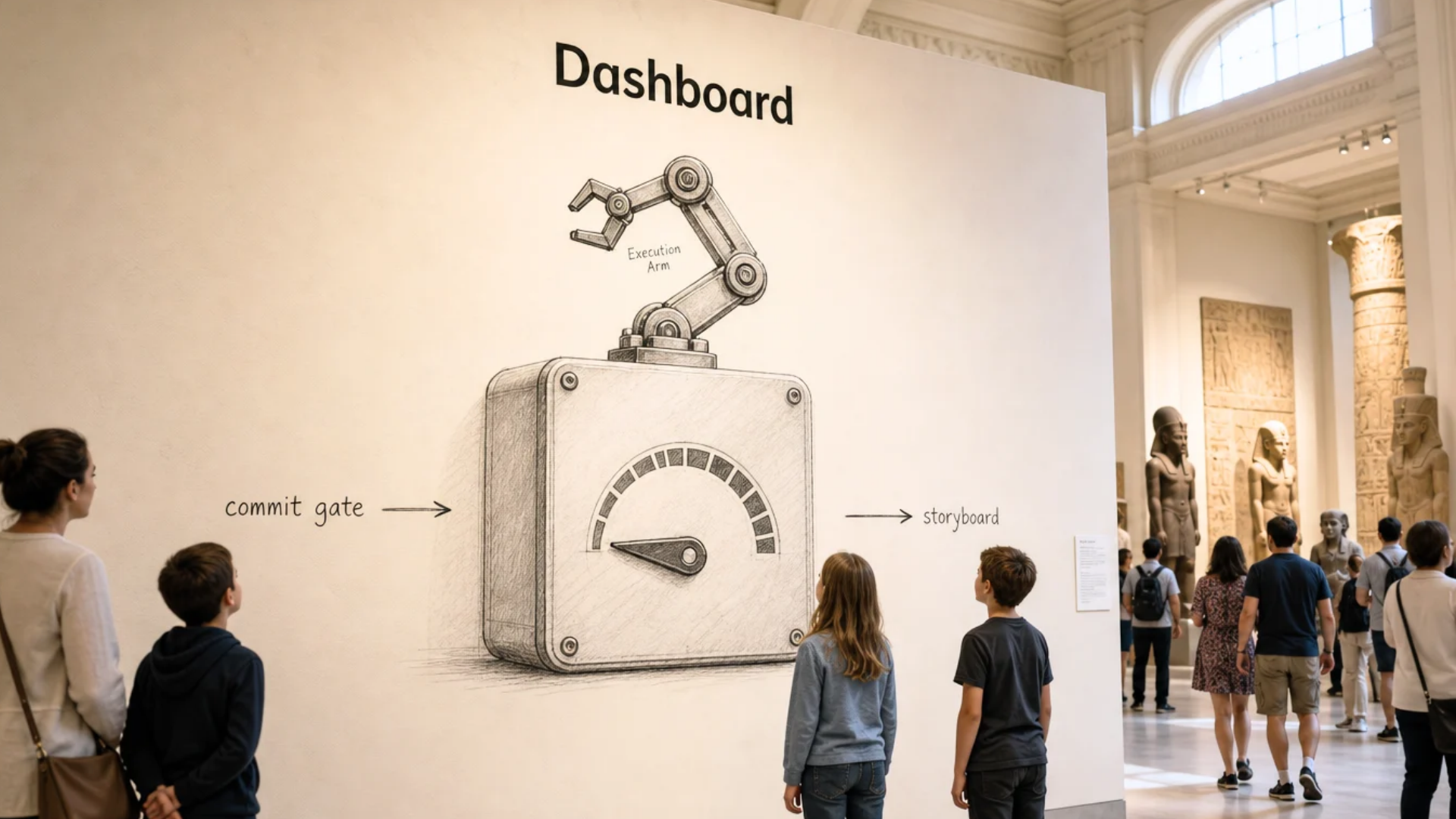
The Dashboard is the component of the Overreaction Machine that converts the committed trajectory into behavior under the machine’s current level of internal activation.
It receives the committed trajectory from the Commit Gate. Its job is not to reconsider that trajectory. It doesn't compare alternatives or decide whether the machine should continue. That choosing work happened upstream.
The Dashboard handles execution. And execution occurs under a continuously changing internal condition: Activation Level.
Where It Sits in the Machine
COMMIT GATE
What are we going to do?
↓
DASHBOARD
How is this commitment being executed under the machine’s current Activation Level?
↓
EXECUTION ARM
Carry out the committed trajectory.
↓
BEHAVIOR
The Execution Arm belongs to the Dashboard. It's not another choosing component. The Commit Gate determines the trajectory, then the Dashboard turns that trajectory into behavior. No second committee meeting is held.
THE GAUGE
The Dashboard is exactly what its name suggests, a gauge. At any moment, the needle sits somewhere along a continuous range.
That reading is: ACTIVATION LEVEL
The machine’s current level of internal activation.
Activation can rise or fall. It can remain elevated after the event that raised it has ended. And because the Dashboard persists across machine runs, the next run does not necessarily begin with the needle conveniently returned to zero. Humans would be considerably easier if it did.
ACTIVATION LEVEL
Activation Level is not a personality trait. It's a current machine state. A machine can be at low activation now and high activation ten minutes later. Another machine can encounter a similar event and move very little.
Activation can change as the machine processes what's happening, and the level produced by previous runs can persist into later ones. This matters because the Dashboard doesn't execute commitments independently of its current state.
As Activation Level rises, Execution Flexibility tends to decrease. The commitment itself doesn't necessarily change. The range of ways available to carry it out narrows.
At lower activation, execution may accommodate more adjustment, interruption, redirection and variation. As activation rises, execution may become less flexible. There's no special line where this suddenly happens, no threshold, no CLICK.
THE EXECUTION ARM
The Dashboard has one Execution Arm.
Its job is simple:
Carry out the committed trajectory.
Suppose the Commit Gate produces:
PARK IN THIS SPACE.
The Execution Arm carries that trajectory into behavior. Back up. Turn. Correct. Pull forward. Try again. The Dashboard’s Activation Level participates in how flexibly that trajectory can be executed.
But the Dashboard does not get to change:
PARK IN THIS SPACE
into:
ABANDON THE SPACE.
That would be a different commitment.
If consequential new information arrives—a horn, a warning from the passenger, a suddenly unavailable space—that information enters through the Antenna and the machine runs again.
The Commit Gate may once again produce:
PARK IN THIS SPACE.
Or it may produce:
GET OUT OF HERE.
Same visible goal does not prove that no new run occurred.
New consequential input can produce a new run and a new commitment. The Dashboard does not quietly renegotiate the old one.
EXECUTION FLEXIBILITY
Execution Flexibility is not another Dashboard setting.
It describes a relationship within the Dashboard operation:
Activation Level ↑
Execution Flexibility ↓
As activation rises, the machine tends to have fewer flexible ways of carrying out the committed trajectory available to it.
That doesn't tell us what the behavior will look like. Less flexible execution might be repetitive, abrupt, persistent, or silent. It might mean continuing to explain or refusing to answer or walking away or sitting perfectly still.
The important distinction is between the internal state of the machine and the visible artifact it eventually produces.
HIGH ACTIVATION DOES NOT MEAN DRAMATIC BEHAVIOR
This is where humans routinely misread the machinery. Someone shouting may be highly activated. And, someone sitting silently may also be highly activated.
Someone may say: “Fine.” Dashboard: 8.
Another person may yell: “OH COME ON.” Dashboard rises sharply, then drops almost immediately.
Visible intensity is not an Activation Gauge.
Behavior is produced by the whole choosing architecture: what the machine noticed, which regulatory engine took control, what futures it generated, what True Costs it assigned, what trajectory it committed to, and the Dashboard state under which that trajectory was executed.
You cannot reliably reconstruct Activation Level by measuring decibels.
ACTIVATION IS NOT EMOTION
The Dashboard is not an emotion meter. Humans may experience high activation as part of anger, fear, excitement, embarrassment, frustration or any number of other states.
But:
Activation Level ≠ emotion.
The Dashboard is tracking something mechanically simpler:
How internally activated is the machine right now?
Two people experiencing what they both call anger may have very different Activation Levels. Two people at similar Activation Levels may describe entirely different emotions. And a machine can be highly activated without providing spectators with the courtesy of looking highly activated. The Dashboard gauge is on the inside.
RECOVERY RATE
Activation Level tells us where the needle is now. Recovery Rate tells us what happens next.
Recovery Rate
How quickly does the Dashboard’s Activation Level tend to return toward baseline after it rises?
This is a configuration difference between machines.
One machine can rise rapidly:
2 → 5 → 8
and then:
8 → 5 → 2
Ten minutes later:
“What are we having for dinner?”
Another machine may reach the same Activation Level and remain elevated for hours.
Or a machine may never reach the same peak but come down much more slowly.
Peak Activation Level and Recovery Rate are separate mechanical questions.
How high did the needle go?
and
How long did it stay there?
Humans frequently collapse those into one trait. The machinery declines.
THE DASHBOARD PERSISTS ACROSS RUNS
This is one of the Dashboard’s most important properties. An interaction does not necessarily consist of one long trip through the Overreaction Machine.
New consequential input can begin another run and another and another. An argument may contain dozens. But the Dashboard doesn't reset between them.
Suppose one run leaves the Dashboard at Activation Level 8. The interaction ends and recovery begins. Five minutes later the Dashboard is still at 6.
Then someone asks:
“Did you remember to buy milk?”
New input. New run. But that input has entered a machine whose Dashboard is already carrying elevated activation. This is one reason the same harmless sentence can participate in very different runs at different times. The milk has done nothing wrong.
RECOVERY RATE CREATES VERY DIFFERENT MACHINES
Consider two specimens. Both encounter an event that pushes their Dashboard to 8.
SPECIMEN A
Activation Level: 8
Ten minutes later: 3
Twenty minutes later: baseline.
SPECIMEN B
Activation Level: 8
Ten minutes later: 7
An hour later: 6
That evening: still elevated.
The original event can be completely over while its Dashboard consequences remain mechanically relevant.
This matters because whatever arrives next enters a machine whose current state includes what has not yet recovered. Same architecture. Different Recovery Rate. Very different afternoon.
EXECUTION IS STILL EXECUTION
There is one trap worth keeping from the previous specimen. When people hear execution, they tend to imagine visible action. Say something. Leave. Fix it. Send the email.
But the committed trajectory can also be: wait, don’t answer, stay quiet, avoid, delay, withdraw, do nothing yet. Silence can be execution. Waiting can be execution. Walking away can be execution.
The Execution Arm does not mean:
DO SOMETHING VISIBLE.
It means:
Carry out the committed trajectory.
Sometimes the machine’s selected behavior remains impressively difficult to photograph.
WHAT THE DASHBOARD DOES NOT DO
The Dashboard does not select the committed trajectory. The Commit Gate already did that.
It doesn't generate possible futures. The Forecast Chamber is upstream.
It doesn't compare True Costs.
It doesn't decide whether new information warrants a different choice. Consequential new information goes through the machine again.
And it doesn't measure how dramatic the human looks.
Its job is narrower:
Maintain the machine’s current Activation Level.
Regulate its return toward baseline through Recovery Rate.
Convert the committed trajectory into behavior through the Execution Arm under that current state.
That's enough work for one box.
THE IMPORTANT CONSEQUENCE
Two humans can produce very similar behavior while their Dashboards are in radically different states. Two humans can also reach similar Activation Levels and produce radically different behavior.
So:
CALM BEHAVIOR ≠ LOW ACTIVATION
and
DRAMATIC BEHAVIOR ≠ HIGH ACTIVATION
Behavior is the artifact. The Dashboard is part of the machinery that produced it.
If someone appears completely calm, the appropriate scientific conclusion is therefore not:
Dashboard: 2.
It is:
We have no idea.
Explore MindStretched
Once you can see the machinery, human choice stops looking quite so weird.