
Two people never see the same world
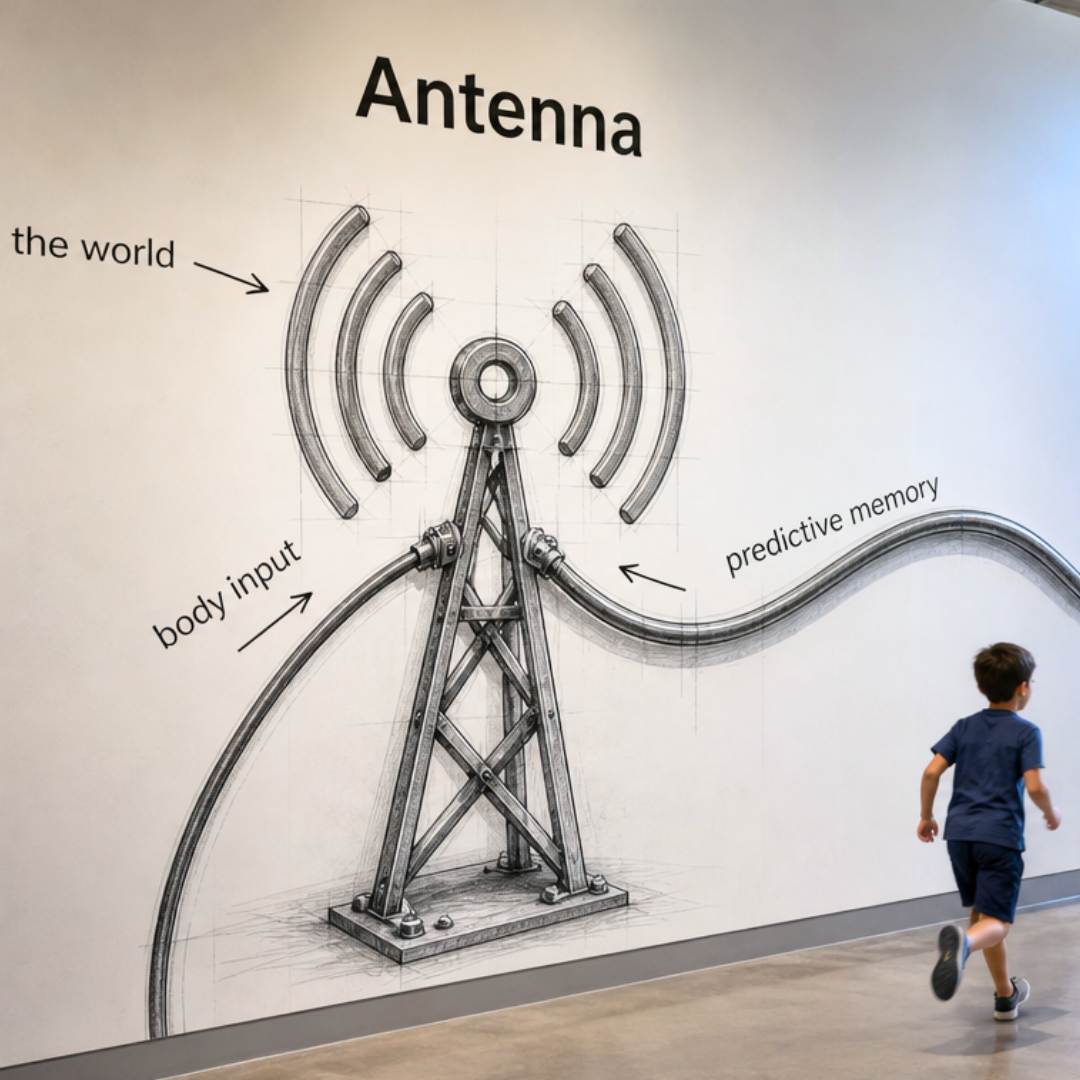
Your Antenna never gets to experience the whole world, it can't, every second reality throws more sights and sounds and smells and tiny shifting details at you than any person could actually process. If you have more than one kid, you know what I mean. When they all talk and want your attention at the same time, it drives you nuts. So before your mind even starts imagining what happens next, something has already happened, your Antenna already decided which signals it’s going to let in and which it’s going to totally ignore.
Imagine an elementary school teacher hangs a giant I Spy picture at the front of the classroom and says, "There's a tiny sailboat hidden somewhere in this picture. See if you can find it."
The room goes quiet in that specific way classrooms go quiet when there's a prize on the line even though there isn't actually a prize. Some kids lean in close like proximity is the trick. One points confidently at something that turns out to be a leaf. Another swears it's behind the tree. A couple have already given up in their minds thinking, This is too hard.
"I found it!"
"You found a duck."
The room laughs and everyone goes back to looking. A few minutes pass before someone actually finds the sailboat, then a couple more find it after that, and some never do.
Here's the part that's actually interesting though, not that some kids found it and some didn't, but that every single kid was looking at the exact same picture. The sailboat didn't move an inch. The information was sitting right there the whole time, equally available to the whole room, and it still got noticed by some kids and not others.
The teacher lets things settle down, then gives the next instruction.
"Here's the sailboat. Now write down five other things you notice."
The room comes alive again. One kid fills his page with animals that were camouflaged from most of the other kids, another writes about the colors that don’t seem to match the objects, like the orange ocean and the green cloud.
"I found a frog."
"What frog?"
"The one by the fence."
"There's no frog."
Within a minute half the class is hunting for a frog that had been sitting there the entire time, unnoticed, until one kid pointed at it and retuned every other Antenna in the room. The picture didn't change. Somebody just said something, and suddenly everyone could see it.
A minute later someone wrinkles her nose, "Does anybody smell popcorn?"
Twenty six little heads turn toward the hallway.
“Oh yeah. I smell it too.”
“Ooooh, I want some.”
That popcorn smell had been drifting through the building for a while already, nothing about it changed, except now people were finally picking it up.
Before the lesson ends the teacher asks one more thing,
“Did anybody notice I wore two different colored socks today?”
Only one hand goes up. One kid out of the whole room caught that. The interesting thing about this is that antennas are already pre-tuned into noticing specific things. Some are tuned toward tiny details like hidden objects in a picture or out of the ordinary things like two different colored socks, others are tuned towards sounds like tone and awkward silences, still others specialize in smells that remind them of things from the past.
This is the part that's easy to get wrong about attention. We like to think it starts when we consciously decide what to focus on, but mechanically it starts way earlier than that. The Antenna is constantly filtering, deciding before you're even aware anything happened which pieces of reality are worth handing off to the rest of the machine, and by the time something reaches your awareness, thousands of other things already got quietly dropped without you ever knowing they existed.
Which is basically why two people can walk through the same day and come back with what sound like two different days. One remembers the person whose joke made everyone double over in laughter. Another remembers the feeling of, Why wasn’t that as funny for me as it was for them? One remembers the smell of rain before the storm even hits, another notices how tightly their mother gripped the steering wheel while driving through deep puddles. Neither one is making anything up, they just got handed different pieces of the same world and never realized it.
You see this even more once someone's spent years inside a craft. A musician catches one instrument drifting slightly flat while everyone else is just enjoying the show. A gardener spots the first hint of disease on a leaf or little cluster of aphids on a bud that looks completely fine to everyone else standing right next to her. The world that people have access to is the same in these cases, their Antenna just got trained, over years, to pick up on signals that are purposefully ignored by other Antennas.
We tend to assume disagreement happens because two people interpreted the same thing differently, but sometimes it's earlier than that, before either person's even formed an opinion or reached a conclusion, before there's technically anything to disagree about yet. Sometimes the disagreement starts with what each mind picked up in the first place, back when nobody was arguing about anything at all.
Explore MindStretched
Once you can see the machinery, human weirdness stops looking quite so mysterious.