ANTENNA
What Gets In
Two people walk into the same room. There are twelve people talking, music playing somewhere behind them, food on a table, a dog wandering around looking for a weak member of the herd, and someone they know standing by the window.
One person notices immediately that the friend looks upset. The other notices that the room is unusually hot. One hears the conversation happening behind them. The other notices the dog. One notices that somebody moved the furniture. The other almost nothing except the person they came to see.
They are standing in the same room. They are not receiving the same world.
Welcome to the Antenna.
What Is the Antenna?
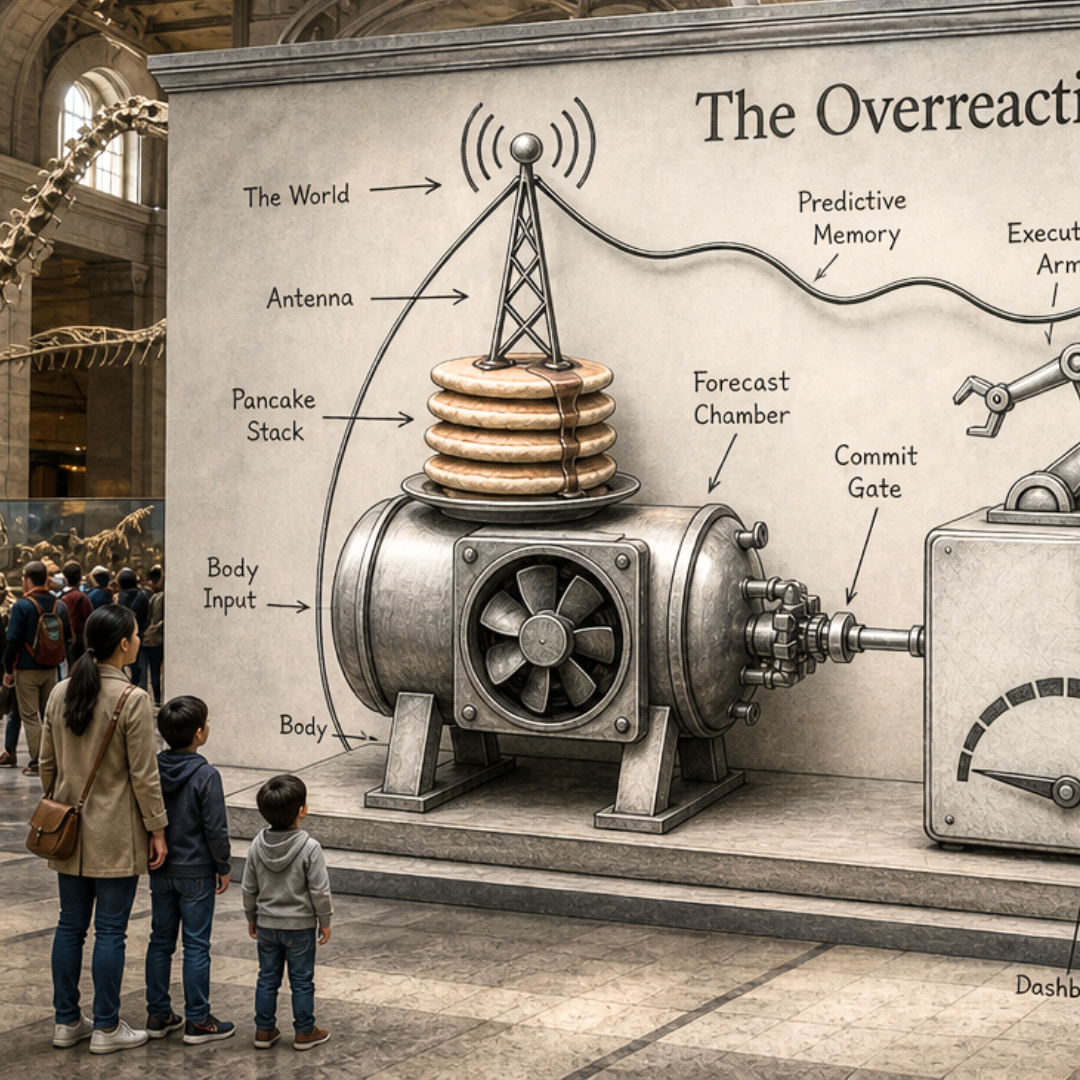
The Antenna is the first component of the Overreaction Machine. It creates the machine's weighted incoming world.
At any moment, far more information is available than can participate equally in processing. Sounds, faces, words, body signals, movement, changes, inconsistencies, remembered patterns and hundreds of other bits of information compete for significance.
The Antenna weights that incoming material. That means some signals become prominent while others remain faint. And some contribute so little that, for practical purposes, they never become part of the world the machine has to deal with. This happens before the machine decides what any of it means. That distinction matters.
Where It Sits in the Machine
THE WORLD
↓
ANTENNA
What gets in, and how strongly?
↓
NESTED STACK
↓
FORECAST CHAMBER
↓
the rest of the trouble
The Antenna sits at the entrance to the machine. It doesn't decide what to do. It doesn't generate possible futures.
It doesn't decide whether the thing you noticed is dangerous, wonderful, insulting, suspicious, or evidence that your marriage is collapsing because someone used a period instead of an exclamation point. Those jobs happen farther inside.
The Antenna determines what material the machine gets to work with.
What Can Enter?
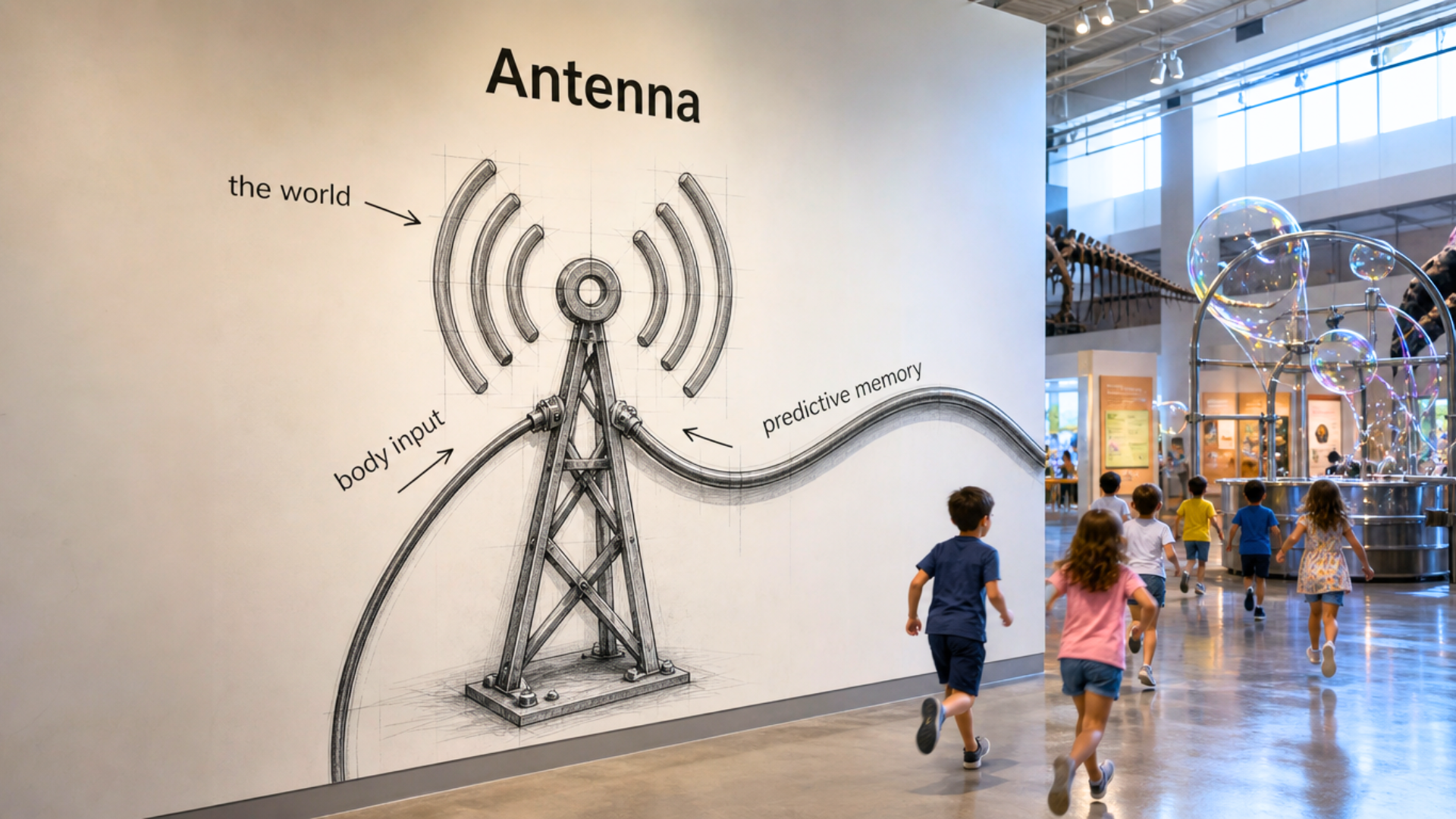
The Antenna isn't merely pointed at the outside world. Its incoming material can include what is happening around the machine, what is happening inside the body, and predictive material activated from Memory Archive.
The expression on someone's face can enter. So can the temperature of the room or stomachache or change in someone's voice. It can notice a contradiction or familiar pattern or physical sensation or something that resembles what happened last time.
The machine's incoming world is therefore not a camera feed of objective reality. It is a weighted collection of signals arriving from multiple sources. And the weighting varies from machine to machine. Quite a lot, apparently.
Antenna Configuration
Every human has an Antenna, but they do not have the same settings. For now, two configuration differences appear to do most of the useful explanatory work.
Signal Weighting
What becomes prominent, and how strongly?
Some Antennas heavily weight social signals. A tiny change in expression or tone becomes prominent immediately.
Others strongly weight inconsistencies. Something doesn't fit the pattern and the machine practically puts a fluorescent arrow over it.
Others give greater weight to body signals, environmental changes, novelty, words, movement, visual detail, familiar patterns, or any number of other available signals.
This doesn't mean one person cares more about these things. We haven't gotten that far into the machine yet. It means the signal arrived in the antenna with more weight.
Signal Density
How much becomes prominent enough to participate?
Some Antennas produce a relatively sparse incoming world. A few signals dominate while much of the rest remains background.
Others produce a dense world. The expression, background conversation, music, movement, temperature, dog, crooked picture frame and strangely aggressive cheese platter may all arrive with enough weight to participate.
Signal Density isn't the same as Signal Weighting. One describes how much gets through strongly enough to matter. The other describes what gets the weight.
Together they help create the particular incoming world presented to the rest of the machine.
What the Antenna Does Not Do
This is where we confiscate several jobs the Antenna has been attempting to acquire without authorization.
The Antenna does not interpret the signal. It doesn't decide what the signal means.
It doesn't determine which kind of instability matters most.
It doesn't generate futures or choose behavior.
If your friend doesn't answer your text, the Antenna may give the unanswered text enormous weight.
But:
She hasn't answered.
is incoming material.
She's angry with me.
is other machinery at work.
She's going to leave me.
We have now traveled considerably farther into the building.
The Antenna's job is simpler.
This is here.
This is loud.
Pay attention to this.
Then it hands the weighted world to the next piece of machinery and, like any properly designed institutional department, denies responsibility for everything that happens afterward.
The Important Consequence
We often begin disagreements with an assumption that is already wrong:
We both saw what happened.
Not necessarily.
Two humans can occupy the same physical environment while their Antennas produce very different weighted versions of it.
One receives the hesitation. Another receives the words. One receives the angry face. Another receives the person across the room smiling. One receives the contradiction. Another barely registers it.
Before interpretation diverges, input can already have diverged.
Which gives us our first useful rule of the Overreaction Machine:
Same environment does not mean same incoming world.
Explore MindStretched
Once you can see the machinery, human choice stops looking quite so weird.