PANCAKE STACK
Who Gets Control
The Antenna has delivered its weighted incoming world.
Now the machine has another problem.
What gets priority?
Imagine your boss sends a message:
Can you come to my office?
One machine immediately starts tracking what might be wrong. Another wonders whether the boss is unhappy with them. Another wants to know what this is about. Another barely reacts until someone adds:
And bring your badge.
Same words. Different machinery starts running the show.
Welcome to the Pancake Stack.
What Is the Pancake Stack?
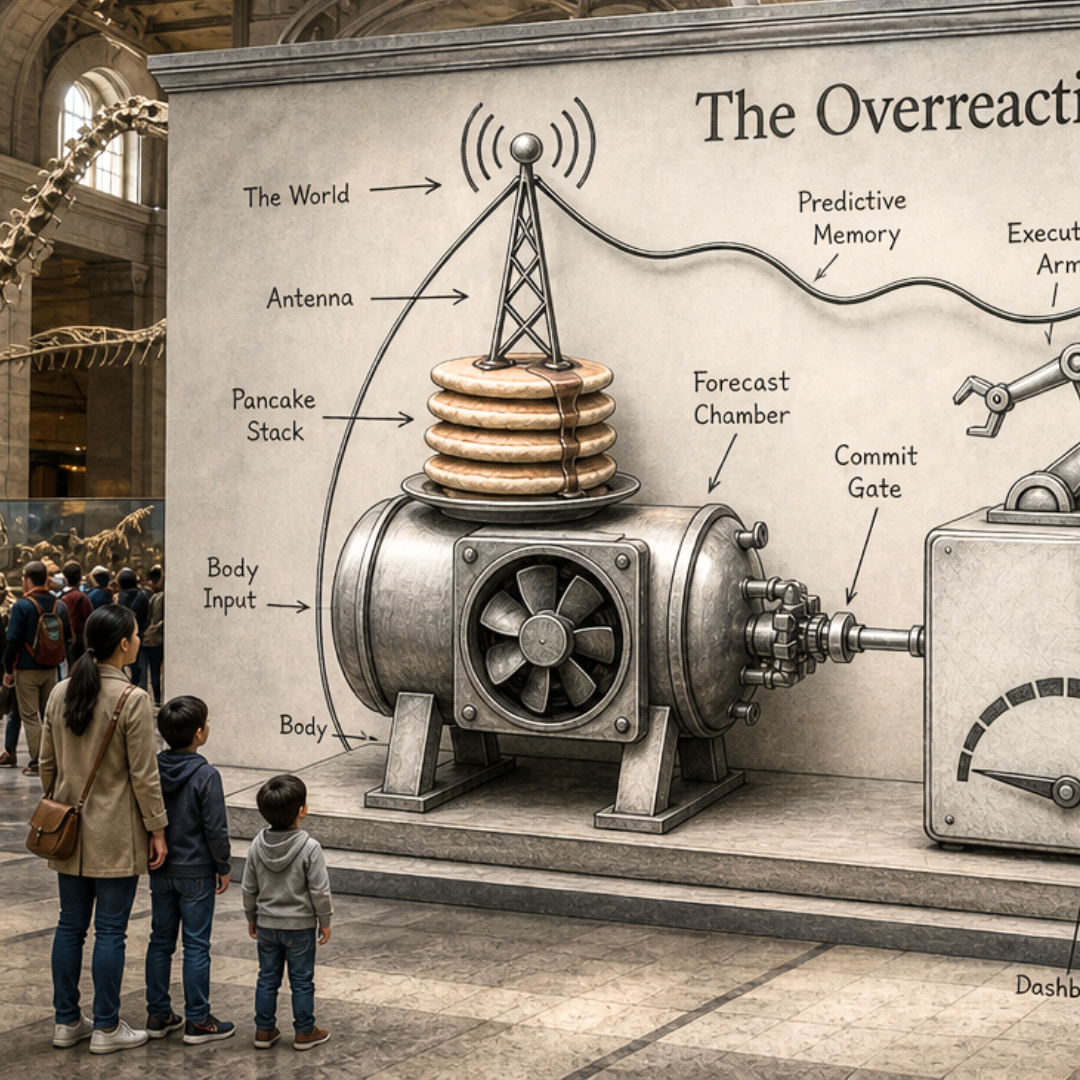
The Pancake Stack is the priority resolver of the Overreaction Machine. Its job is to determine which regulatory engine controls forecasting at any given moment.
Every human machine contains the same four regulatory engines:
Survival protects physical stability.
Pattern protects predictive stability.
Social protects relational stability.
Logic protects explanatory stability.
All four remain available, but they don't get equal control.
At any given moment, one engine sits on top of the Stack and controls the Forecast Chamber. The others continue operating, but they don't direct forecasting.
We considered forming a committee but the pancakes declined.
Where It Sits in the Machine
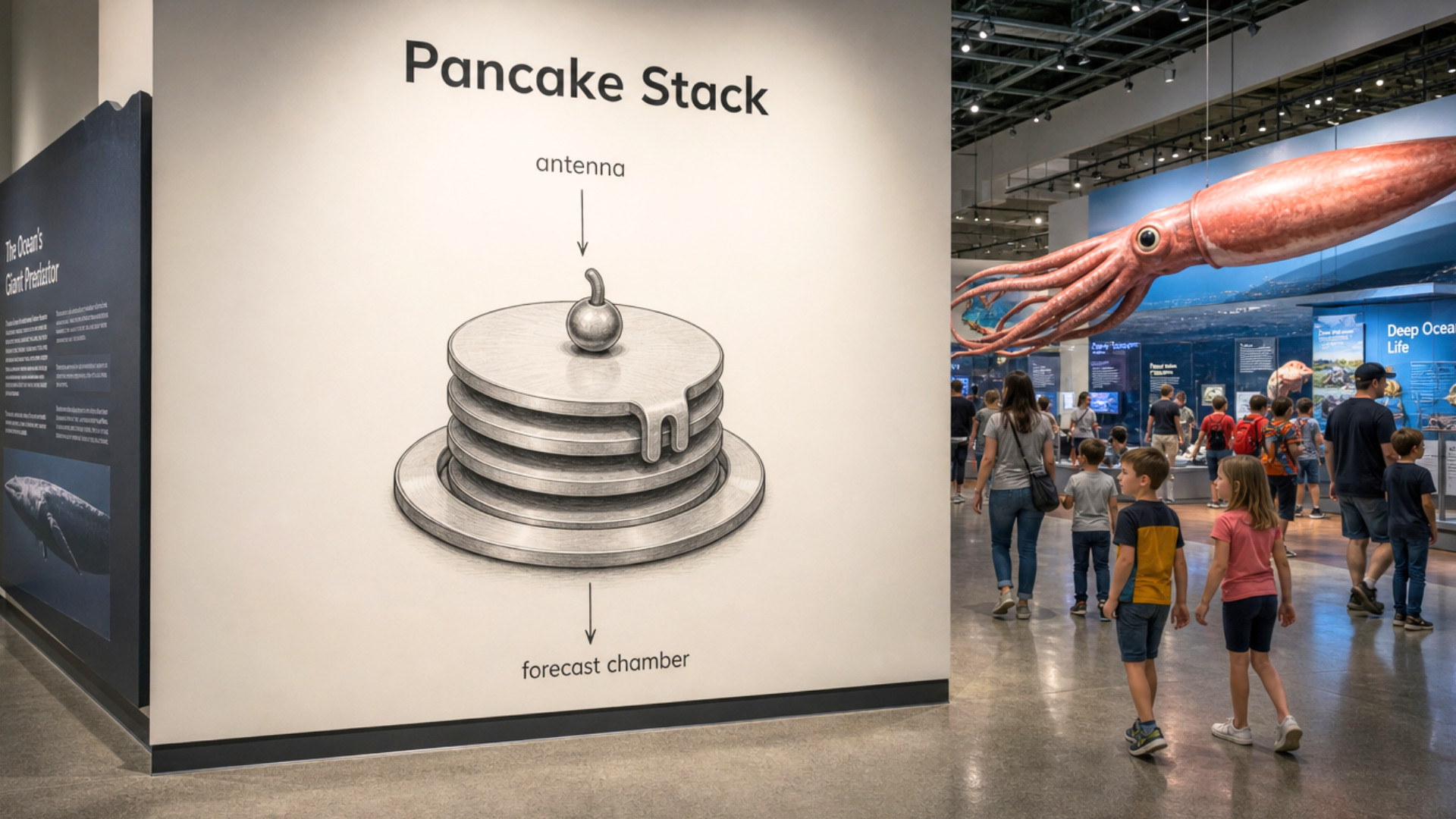
ANTENNA
What entered, and how strongly?
↓
PANCAKE STACK
Which regulatory engine gets control?
↓
FORECAST CHAMBER
What could happen next?
The Antenna supplies the weighted incoming world.
The Pancake Stack resolves who gets control.
The Forecast Chamber takes it from there.
This division of labor matters. The Stack doesn't create the possible futures that come next. It determines which regulatory engine gets to control their production.
Meet the Pancakes
The four engines perform different regulatory jobs, but they aren't four different kinds of humans. Everybody gets all four.
Survival
Regulatory job: physical stability
Survival tracks conditions relevant to keeping the organism physically viable: injury, illness, physical threat, resource loss, bodily danger and other conditions that can materially affect physical security.
Most Tuesday afternoons, it has no reason to seize the building. Occasionally it does. When Survival takes the top position, physical stability gets priority.
Pattern
Regulatory job: predictive stability
Pattern wants the world to remain sufficiently predictable. It tracks regularity, expectation, sequence and mismatch. Something normally happens this way but today it didn't.
The restaurant is unexpectedly closed.
Someone who always calls hasn't called.
The usual process suddenly changed.
Nothing necessarily has to be dangerous or socially threatening. The prediction failed and Pattern would like an explanation—or at least for the world to start behaving itself again.
Social
Regulatory job: relational stability
Social tracks the human environment. Acceptance, rejection, belonging, reputation, cooperation, conflict, status and changes in important relationships can all make Social highly relevant.
A raised eyebrow may be almost irrelevant to one machine and enough to rearrange another one's entire Stack. Humans did, regrettably, evolve around other humans. Social has had steady employment ever since.
Logic
Regulatory job: explanatory stability
Logic tracks whether the machine's explanation of reality holds together.
Does this make sense?
Is the claim internally consistent?
Does the evidence fit the model?
What explains the contradiction?
Logic is not synonymous with intelligence, education or being correct. A Logic-controlled machine can construct an extremely elaborate explanation of something that isn't true. It merely insists that the explanation hold together. Reality has filed several complaints about this arrangement.
Every Pancake Runs the Same Machinery
The engines have different regulatory objectives, but they use the same basic computational loops.
Each continuously runs:
Error Reduction
What doesn't match expectation?
Pattern Retrieval
What relevant predictive information has been learned before?
Expectation Modeling
What is likely to happen next?
Energy Budgeting
How much regulatory effort is this worth?
Risk Calculation
What happens if this regulatory objective isn't protected?
The five loops aren't five more components of the Overreaction Machine. They are recurring operations running inside each regulatory engine. The engines differ in what they are regulating, not because one has access to reasoning while another has been issued a small emotional tambourine. They have the same loops but a different objective.
Pancake on Top Wins
This is the rule worth remembering.
The Pancake Stack does not average the four engines.
It does not send 40% Logic, 30% Social, 20% Pattern and 10% Survival into the Forecast Chamber.
One engine controls forecasting at a time.
The remaining engines continue monitoring and running their loops. But their output does not guide the Forecast Chamber while another engine controls the Stack.
So if Social is on top, the machine's forecasts are being organized under relational regulation.
If Pattern takes control, predictive stability becomes the controlling objective.
If Logic takes over, explanatory stability controls forecasting.
And if Survival takes the top position, the other pancakes may submit their concerns in writing.
Pancake Stack Configuration
Every machine has the same four pancakes but they are not stacked the same way. Two configuration differences do most of the useful explanatory work.
Default Engine Order
Which engines normally receive priority?
Every machine has a relatively stable default arrangement.
One might ordinarily run:
Logic → Pattern → Social → Survival
Another:
Social → Survival → Pattern → Logic
Another:
Survival → Pattern → Logic → Social
The default order doesn't determine behavior. It doesn't even guarantee which engine will control the next event.
It tells us which engine normally receives priority when nothing is strongly overriding the arrangement. Think of it as the pancakes' assigned seating, although assigned seating is about to prove unreliable.
Activation Sensitivity
How readily does each engine become competitive for control?
The Stack is not glued together. Signals can change engine activation.
Suppose Logic normally sits above Social. Then someone laughs while you're presenting your work.
For one machine, Social barely stirs.
For another, Social activation shoots upward and,
clunk.
Social is now on top.
The machine hasn't acquired a new personality. Its default configuration hasn't changed.
Control changed.
This is why knowing someone's default Stack does not tell you which engine will control them in every situation. The current signal still matters. The state of the machine still matters.
What the Pancake Stack Does Not Do
The Stack has one job, and we're going to make it stay there.
It does not decide what entered the machine.
That was Antenna.
It doesn't generate possible futures.
That's Forecast Chamber.
It doesn't calculate which future is most affordable.
We're not at True Cost yet.
It doesn't choose behavior.
We are nowhere near behavior.
And importantly, the Stack does not decide which engine is correct.
Logic isn't the good pancake.
Social isn't the irrational pancake.
Survival isn't the primitive pancake.
Pattern isn't the anxious pancake.
They regulate different requirements of the same human machine.
The Pancake Stack merely answers:
Given this machine, in this state, receiving this weighted input—which regulatory engine gets control of forecasting?
Then it hands the controls over.
The Important Consequence
This gives us another reason two humans can receive the same event and rapidly head toward different realities.
Their Antennas may have delivered very similar weighted signals.
But their Stacks may not give those signals to the same regulatory engine.
One machine receives criticism and Logic takes control:
What exactly is wrong with the argument?
Another receives the same criticism and Social takes control:
What does this mean about how they see me?
Another hands it to Pattern:
Why is this happening? I thought everything was going well.
The disagreement hasn't even started yet.
The machines are already solving different problems.
Explore MindStretched
Once you can see the machinery, human choice stops looking quite so weird.