MASTER DIVIDES
Four Ways Human Machines Lean
Put two humans in the same situation and give them the same information and plenty of time. Also, make them equally intelligent. They can still disagree about what would make the situation better.
One wants more protection. The other wants more freedom. One needs to understand why something matters. The other would greatly prefer for Tuesday to behave like Tuesday usually behaves.
One trusts what feels significant. The other starts checking whether the pieces fit. One would rather preserve a long-standing belief. The other will happily throw the belief overboard if the evidence stops supporting it.
This isn't necessarily a failure of reasoning. The machines may be leaning in different directions before the reasoning even begins.
Welcome to the Master Divides.
What Are the Master Divides?
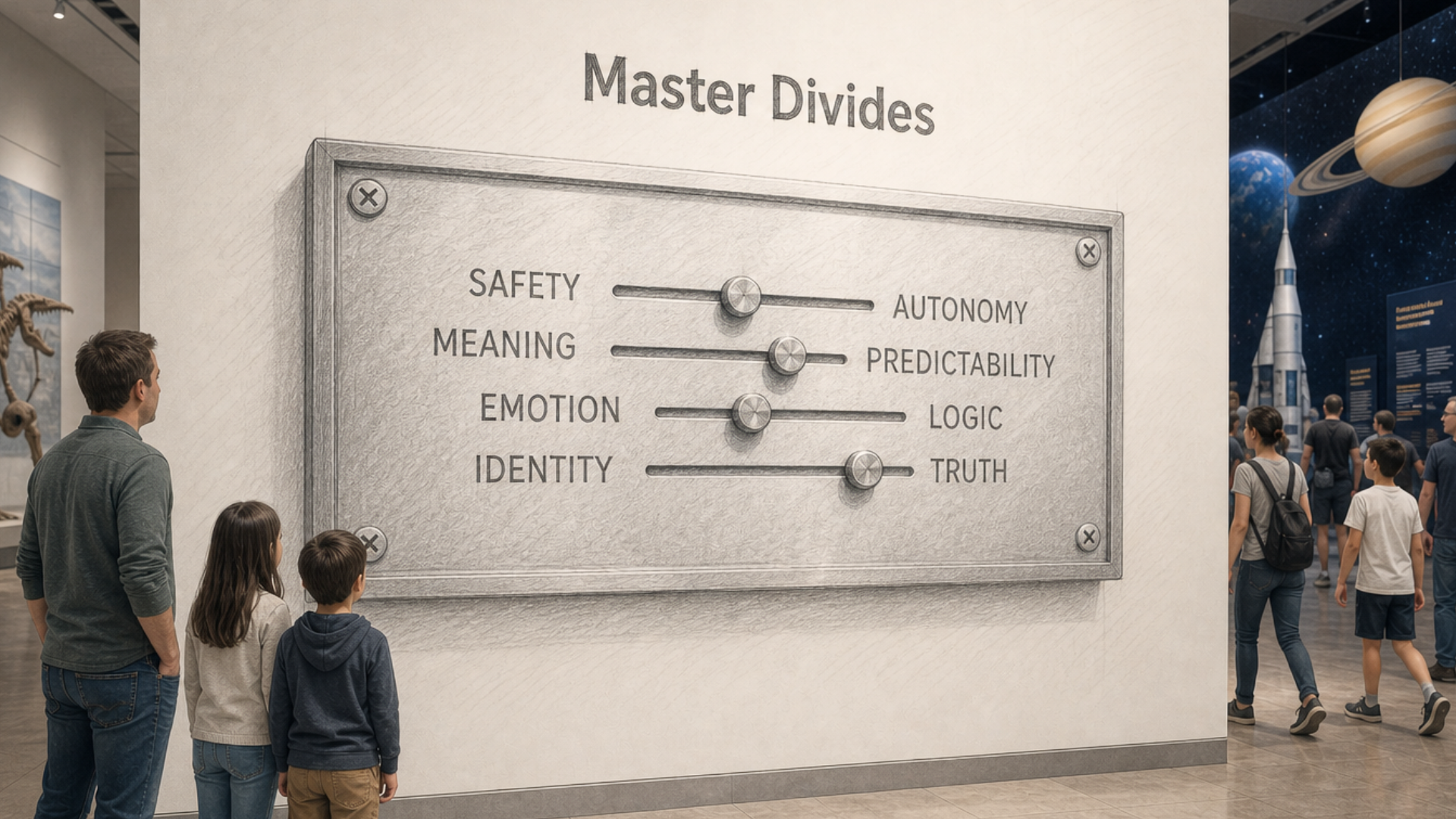
The Master Divides are four global configuration axes that establish the operating orientation of the Overreaction Machine.
They are:
Safety ↔ Autonomy
Meaning ↔ Predictability
Emotion ↔ Logic
Identity ↔ Truth
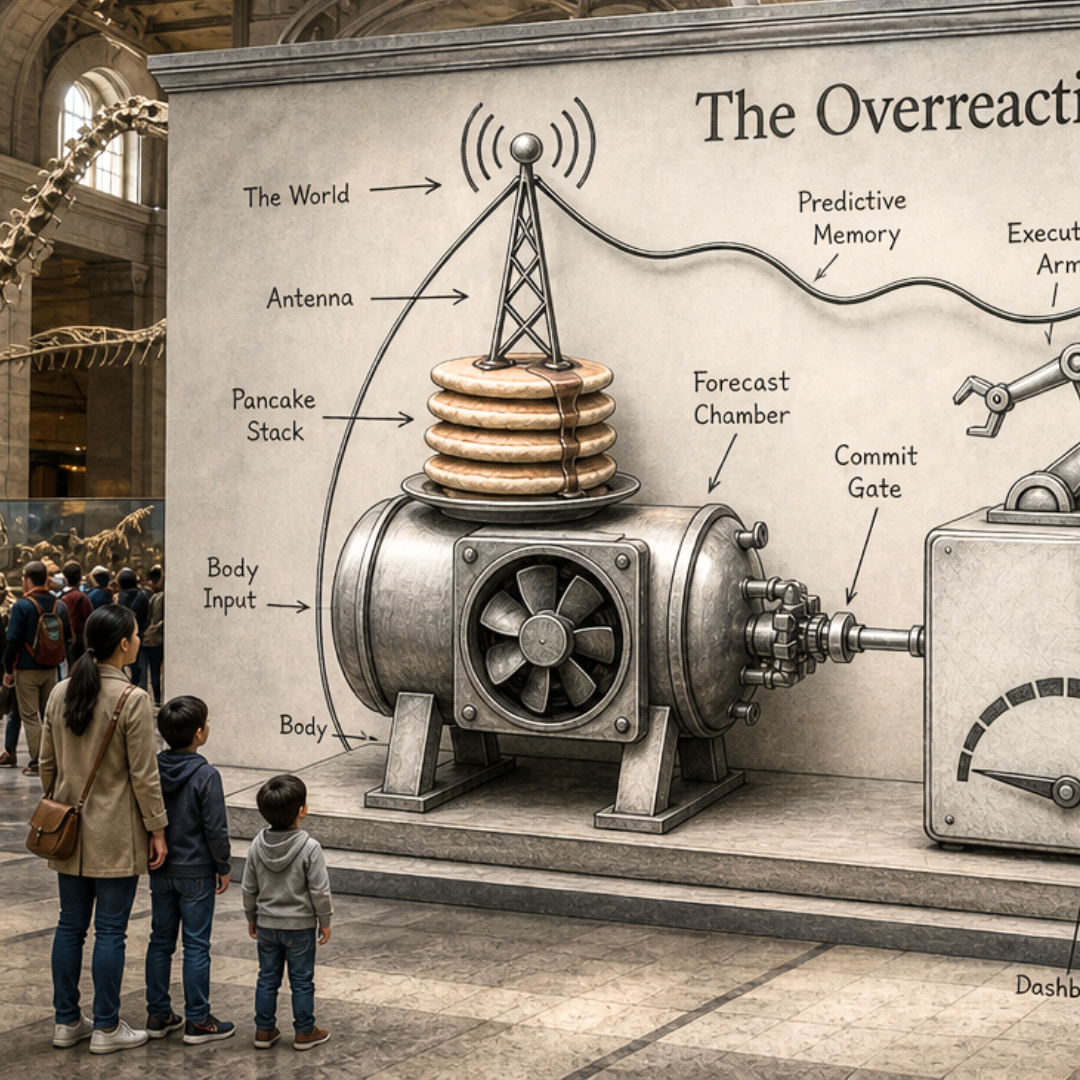
Unlike the Antenna or Nested Stack, the Master Divides are not components of the machine.
You cannot open the machine and find the Identity Lever tucked conveniently behind the Forecast Chamber. They are configuration.
And unlike a component setting such as Signal Density or Default Engine Order, a Master Divide isn't confined to one piece of machinery. It can influence multiple parts of the machine at once. Think less part inside the machine. Think more how this particular machine is calibrated.
Four Divides. Four Questions.
Each Master Divide answers one fundamental question.
SAFETY ↔ AUTONOMY
Where does stability come from?
A machine oriented toward Safety places greater weight on stability through protection, support, external security, shared structure and reliable containment.
A machine oriented toward Autonomy places greater weight on stability through independence, self-direction, freedom of movement, internal control and low external constraint.
Neither side is asking:
Do I want to be safe?
Everyone would generally prefer not to be hit by a bus.
The difference is where the machine tends to locate stability.
For one machine:
I'll be okay if I have enough support.
For another:
I'll be okay if nobody traps me.
Which means the exact same thing can look stabilizing to one machine and expensive to another.
More structure, more help, more rules. More independence, more oversight, more freedom.
One person's railing is another person's fence.
MEANING ↔ PREDICTABILITY
What makes the world stable?
A machine oriented toward Meaning places greater weight on purpose, significance, interpretation, symbolic connection and why something matters.
A machine oriented toward Predictability places greater weight on consistency, regularity, repetition, reliable outcomes and knowing what happens next.
Imagine two people doing the same job. One can tolerate uncertainty surprisingly well if the work feels important. The other doesn't require a grand mission. A clear role, reliable expectations and a system that continues functioning tomorrow would be lovely.
One asks:
What does this mean?
The other asks:
What happens next?
Neither question is universally superior, but they can produce very different machines... and some extremely long meetings.
EMOTION ↔ LOGIC
How is instability regulated?
An Emotion-oriented machine gives greater weight to affective information, felt experience, experiential coherence and emotional significance.
A Logic-oriented machine gives greater weight to analysis, consistency, model coherence, explanatory structure and reasoning.
This does not mean: emotional person ↔ logical person.
That would be ordinary human labeling wearing a laboratory coat. Everyone has emotions. Everyone uses reasoning.
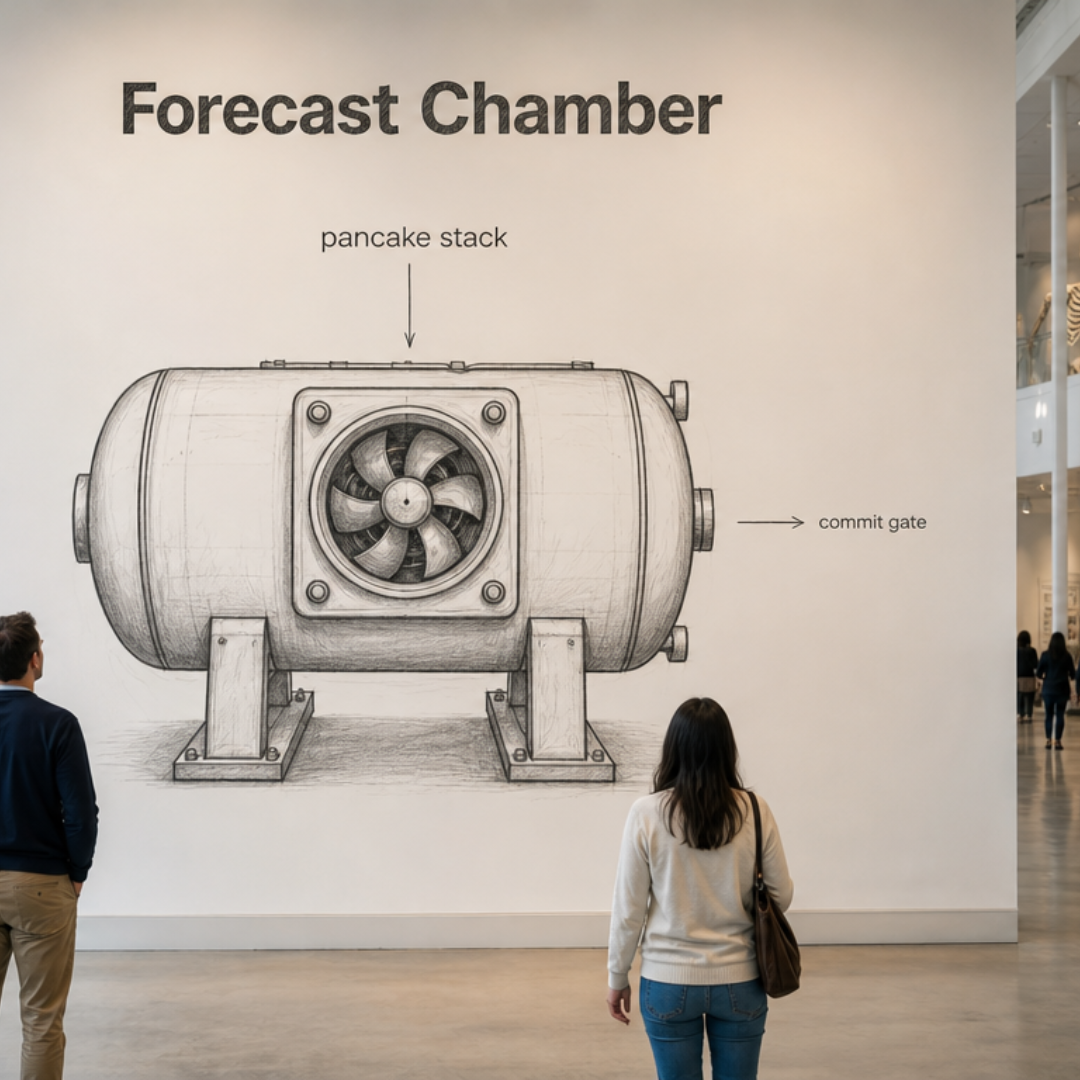
And remember, every machine also contains a Logic regulatory engine inside the Nested Stack. The Logic end of this Master Divide is not that pancake.
The Nested Stack's Logic engine is a component with a specific regulatory job.
Emotion ↔ Logic is a global orientation.
One describes machinery. The other describes how the machinery tends to be calibrated across the system. Same word, different floor of the museum. We should probably put up a sign.
IDENTITY ↔ TRUTH
What is preserved when updating becomes necessary?
This may be the easiest Divide to see once you know what you're looking for.
An Identity-oriented machine places greater weight on preserving self-continuity, existing beliefs, social identity, established interpretation and coherence with the existing self-model.
A Truth-oriented machine places greater weight on preserving correspondence with external evidence, model correction, contradiction detection, accuracy despite disruption and revision when the evidence requires it.
Suppose new evidence contradicts something a person already believes. Now the machine has a problem. Updating the belief improves correspondence with the evidence. But updating may also disrupt identity, belonging, previous decisions, existing explanations or the person's model of themselves. Something may have to move.
Identity-weighted machines place greater pressure on preserving continuity. Truth-weighted machines place greater pressure on correcting the model. This does not mean Identity-oriented machines always reject evidence or Truth-oriented machines wander around heroically accepting every unpleasant fact. These are weights, not commandments.
But when evidence and continuity pull in opposite directions, this Divide becomes particularly visible. Sometimes the investigation stops because the evidence is weak. Sometimes it stops because the existing model is expensive to disturb. Those are not the same machine event.
These Are Divides, Not Boxes
The four Master Divides are shown as pairs because pairs make the machinery easier to inspect. Actual humans have been less cooperative. Each Divide is a continuum.
A specimen can lean strongly toward Safety, mildly toward Safety, sit near the middle, lean toward Autonomy, or move somewhere else along the axis. The same is true of all four.
So:
Safety ↔ Autonomy
does not create two kinds of humans.
And four binary Divides do not magically produce sixteen natural human species.
If we temporarily reduce each Divide to two poles, we can produce sixteen simplified primary machine classes. That's useful for classification, but it's also an enormous simplification. The Classification wing will enjoy this for several minutes before component configuration destroys everything.
What the Master Divides Do Not Do
The Master Divides do not generate behavior, which means they don't tell us what someone will do.
They don't replace the Antenna or determine which Nested Stack pancake currently has control. They don't generate forecasts or make decisions. And they are not personality traits.
A strongly Autonomy-oriented specimen can accept help. A Meaning-oriented specimen can love routines. An Emotion-oriented specimen can make an analytical argument. A Truth-oriented specimen can defend a false belief.
Configuration changes how the machine operates.
The machine still has to run.
A signal still enters, the Antenna weights it, the Stack resolves control, the Forecast Chamber generates possibilities, and memory contributes prior predictive material.
Current body state matters. The rest of the machine does its considerable amount of paperwork and only then do we eventually get behavior.
This is why MindStretched classifies machinery rather than artifacts.
Global Configuration vs. Component Configuration
This distinction is worth putting behind glass.
MASTER DIVIDES
Global configuration
A Master Divide influences multiple parts of the machine.
COMPONENT CONFIGURATION
Local configuration
A component setting changes one particular piece of machinery.
Signal Weighting, for example, belongs to the Antenna.
Default Engine Order belongs to the Nested Stack.
Later we'll encounter settings belonging to the Forecast Chamber, Commit Gate, Dashboard, Memory Archive and Storyboard.
The architectural rule is simple:
If a setting changes one component, it belongs to that component. If it influences multiple components, it may belong in global configuration.
No setting gets two offices.
The Important Consequence
The Overreaction Machine gives us one universal architecture. The Master Divides give that architecture directional bias before the current event ever arrives.
So two machines can have the same parts and still approach the world differently.
One tends to find stability through support, another through independence.
One through significance, another through regularity.
One gives greater regulatory weight to felt experience, another to explanatory consistency.
One protects continuity when a model is challenged, another more readily protects correspondence with outside evidence.
None of this tells us what either person will do next.
It tells us something more useful:
what kind of machine is about to process whatever happens next.
Explore MindStretched
Once you can see the machinery, human choice stops looking quite so weird.