MEMORY ARCHIVE
What Yesterday Gets to Tell Tomorrow
Something happened yesterday then the Storyboard compressed it. Now the machine has a problem. What should it do with it? Keep the entire event forever? Probably not. Throw it away? Also inefficient.
Instead, the machine extracts and maintains information that may help it deal with what happens next.
The restaurant made you sick.
The shortcut saved twenty minutes.
That person kept their promise.
The pan was hot.
The joke did not go well.
This is useful stuff to know, so file accordingly.
Welcome to the Memory Archive.
What Is the Memory Archive?
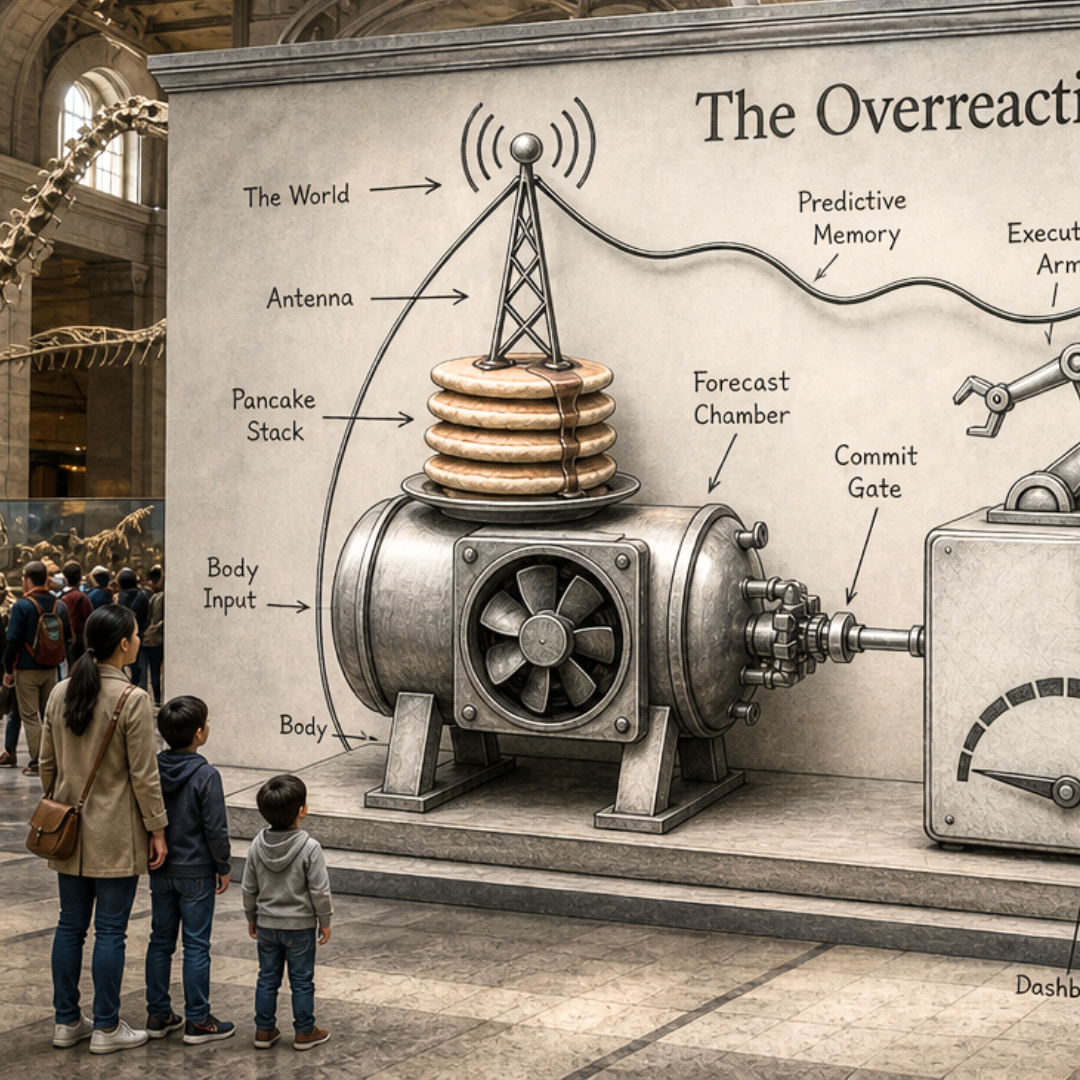
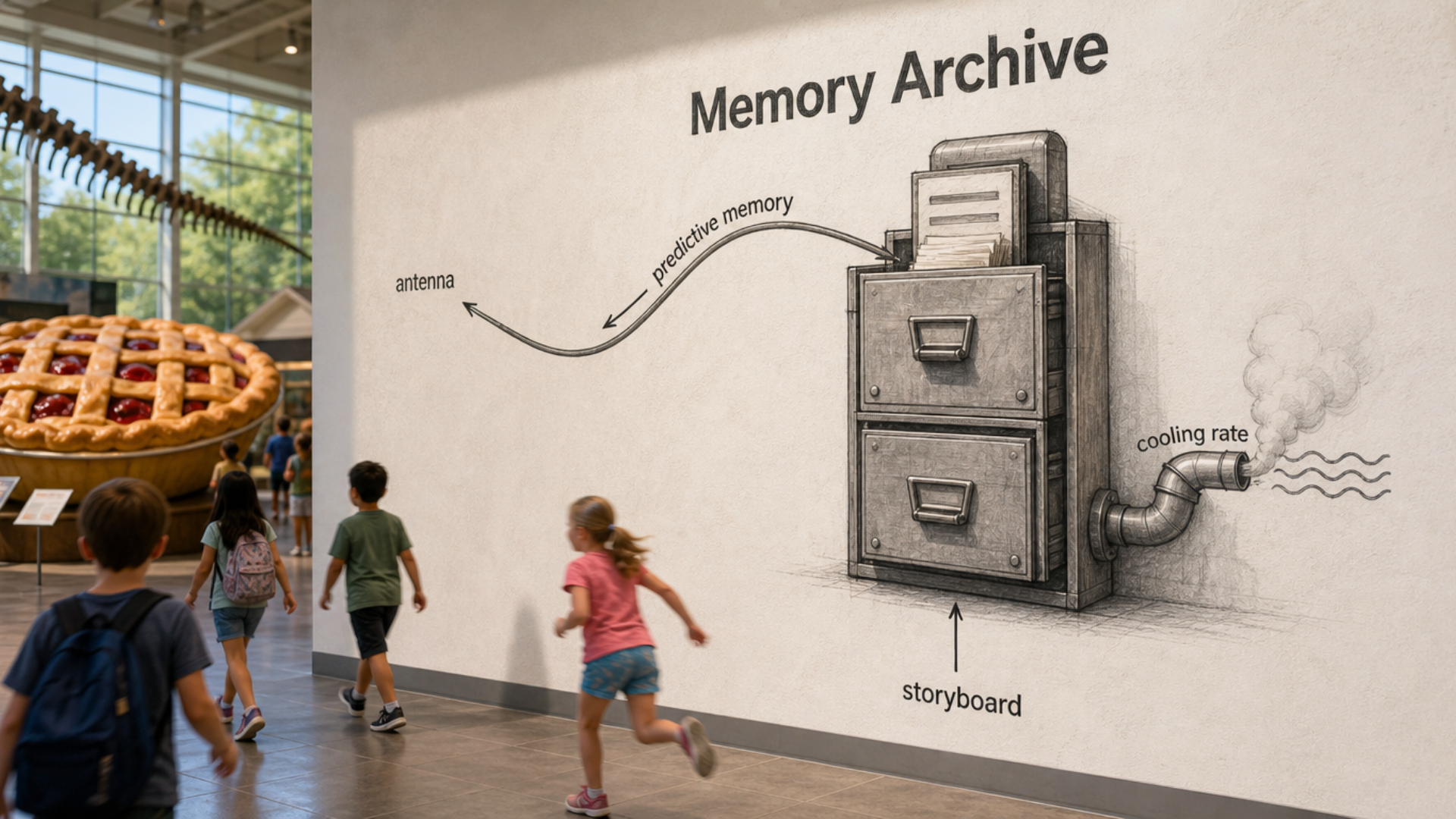
The Memory Archive is the updating component of the Overreaction Machine. It uses completed experience to build, maintain and revise predictive structures that can participate in future processing.
That last part matters. Memory is not here primarily to preserve the past. It is here to improve prediction.
The machine doesn't need a perfect recording of Grandma's kitchen.
It needs: HOT TRAY → BURN
It doesn't necessarily need every detail of the restaurant where you got food poisoning.
It would be useful to retain:
THAT SMELL → POSSIBLE TROUBLE
The past earns its keep by becoming useful to the future.
Where It Sits in the Machine
STORYBOARD
What representation of the completed trajectory gets carried forward?
↓
MEMORY ARCHIVE
What should the machine learn from this?
↓
PREDICTIVE MEMORY
↓
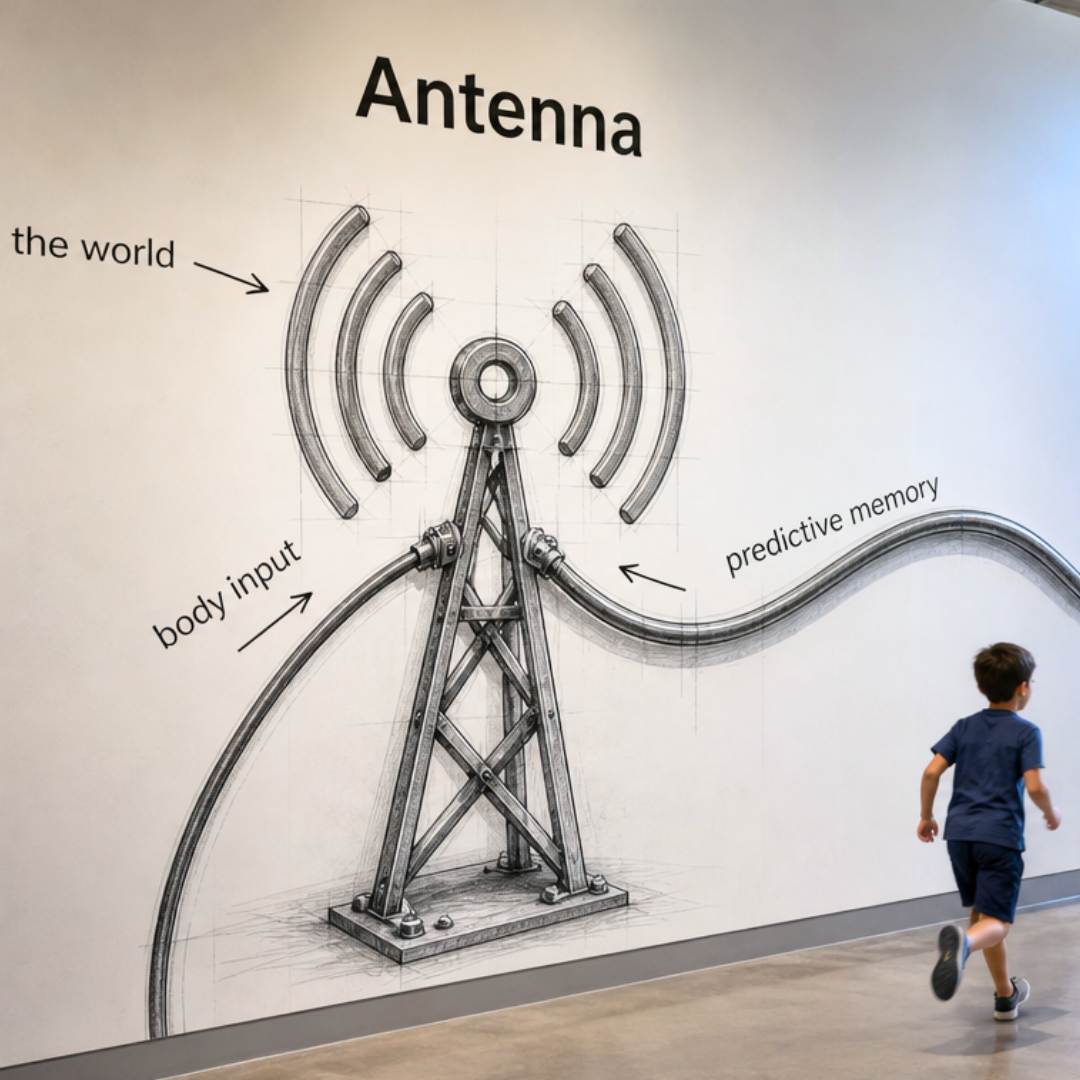
ANTENNA — NEXT RUN
And there is our circle. The machine does not travel backward. Yesterday's completed processing becomes predictive material available to tomorrow's machine.
Every new event completes a new run, but not with a blank machine. The machine that meets today has already been modified by yesterday.
The Archive Does Not Just Store Events
This is where the filing-cabinet metaphor becomes slightly misleading.
Imagine touching a hot pan. The useful product of that experience isn't necessarily a beautifully preserved memory containing: the date, the kitchen, the weather, the shirt you were wearing, the exact shape of the pan, and the expression on the dog.
The useful product is a predictive structure:
HOT OBJECT → POSSIBLE BURN
That structure can now participate in processing situations that have never happened before. Different pan, different kitchen, different day, but the same useful prediction. That's the important thing about the Archive.
It doesn't merely preserve what happened. It changes what the machine expects to happen next.
Memory Archive Configuration
Now things get interesting. Two people can experience remarkably similar events and still carry very different versions of yesterday into tomorrow.
For now, seven configuration variables appear to do useful explanatory work. Yes, that's a lot. Fortunately, they organize into four jobs.
1. GENERALIZE
Generalization Width
How broadly does learned predictive material apply beyond the original situation?
Suppose one person betrays you.
A narrow generalization might produce:
That person wasn't trustworthy.
A broader one:
People like that aren't trustworthy.
Broader still:
People aren't trustworthy.
One event. Increasingly large predictive territory. That's Generalization Width.
This matters because an experience doesn't need to happen repeatedly if the machine generalizes broadly enough from the first one.
A single event can become information about:
this person
or
this kind of person
or
people.
The Archive decides how much territory the lesson gets to occupy.
2. RETRIEVE
Storing predictive material isn't particularly useful if it can never participate again. So the Archive needs retrieval.
And there are two important questions:
How easily does something come back?
and
What comes back?
Retrieval Threshold
How much similarity or relevance is required before stored predictive material becomes active?
Imagine meeting someone new. They do something vaguely similar to something another person did years ago.
For one machine:
Nothing particularly interesting happens.
For another:
We've seen this before.
The old situation doesn't have to be identical. It merely has to match strongly enough to cross that machine's Retrieval Threshold. A lower threshold allows more distant matches to activate stored predictive material. A higher threshold requires a closer match.
So two people can enter the same new situation carrying very different amounts of old information into it. Not because one has a past and the other doesn't. Because different past material became active.
Retrieval Format
Then there is the stranger question:
What does remembering actually look like inside this machine?
Our current continuum is:
REPRESENTATIONAL ↔ STRUCTURAL
At the representational end, stored material may become available as things that can be mentally inspected:
images, words, sounds, scenes. episodes, contextual detail
Someone remembers the spelling of a word by effectively seeing the word. Another remembers where they were when they hear a certain song. A third remembers an embarrassing event from 1987 because apparently the Archive has restored the original film and scheduled a surprise screening.
At the structural end, retrieval may arrive primarily as:
patterns, associations, knowledge, familiarity, expectations, predictions
without much conscious access to the experience from which they came.
Which produces one of the great sentences of human cognition:
I know this. I have absolutely no idea how I know this.
The information is there, but the documentary footage is not.
Knowing Is Not the Same as Replaying
This distinction gives us an important correction. People often judge their memory by their ability to consciously revisit the past.
I have a great memory.
I have a terrible memory.
But those statements can hide very different machinery.
Someone may retrieve vivid scenes, conversations and contextual details.
Another person may retrieve relatively little episodic representation while carrying enormous amounts of structural knowledge extracted from previous experience.
They know, recognize, connect patterns, and anticipate what will come next. They simply can't show you the original footage.
So:
Poor access to the past does not necessarily mean the past failed to modify the machine.
The Archive may have kept the lesson and discarded—or made inaccessible—the slideshow.
3. UPDATE
Now we reach the Archive's central job. Predictive structures are useful. Permanent predictive structures would be a disaster.
The world changes. People change, situations differ, predictions fail and new evidence arrives. The Archive therefore has to revise itself. And updating turns out to have several separate properties.
Update Threshold
How much conflicting evidence is required before an existing predictive structure begins meaningful revision?
Suppose the Archive contains:
DOGS ARE DANGEROUS.
Then you meet a friendly dog. Does the model change? Maybe not. One contradictory event may be treated as an exception.
Then another friendly dog, and another, and at some point, the accumulated evidence may become sufficient to challenge the existing predictor.
Different machines need different amounts of contradiction before that happens. That's Update Threshold.
One machine says: Interesting exception.
Another says: We may need to revise the file.
Same evidence with a different threshold.
Crossing the threshold doesn't mean the old predictor instantly disappears.
This isn't: OLD MODEL delete
NEW MODEL install
Predictive structures can weaken gradually as competing evidence accumulates.
Dogs are dangerous.
becomes:
Most dogs are probably dangerous.
then:
Some dogs are dangerous.
then perhaps:
This depends considerably on the dog.
That transition can take time.
Update Rate
How quickly does an existing predictive structure change as new evidence accumulates?
And Update Rate can vary by context and by the size of the required revision.
Changing:
This restaurant isn't as good as it used to be.
is a considerably smaller renovation than:
My model of people has been wrong for thirty years.
The Archive charges extra for structural work.
Update Balance
There is another complication. Evidence does not necessarily update the model symmetrically.
Suppose the Archive contains:
PEOPLE WILL LET ME DOWN.
Then someone proves reliable. That's useful evidence. Then again and again. Small update.
Now they let you down once. THUNK. Major update.
That machine gives negative evidence more updating power than positive evidence.
Another machine may do the opposite.
Update Balance
How differently do positive and negative evidence alter predictive structures?
This matters because merely counting experiences doesn't tell us how the Archive is learning from them.
Ten pieces of evidence in one direction may not mechanically equal one powerful piece in the other. The Archive has weights, naturally.
Updating Is Not Changing Your Mind
This distinction is worth making. We often imagine updating as a conscious intellectual event:
I have reconsidered the evidence and changed my opinion.
Sometimes. But the Archive can update predictive structure without issuing a press release.
A place starts feeling safer. A person becomes easier to trust. A task no longer seems impossible. A situation that once seemed ordinary begins producing caution.
The predictive landscape can shift gradually before Storyboard ever produces:
I've changed my mind.
Updating is machinery. The explanation can arrive later.
4. COOL
Finally, predictive material doesn't necessarily retain the same influence forever.
Enter:
Cooling Rate
How quickly does stored predictive material lose influence when it is no longer being reinforced or retrieved?
Something terrible happens Monday. On Tuesday, it strongly participates in constructing the world. Wednesday, somewhat less. A month later, perhaps barely at all.
Another machine may carry the same predictive influence much longer.
That's Cooling Rate.
And this gives us a useful distinction:
Remembering an event is not the same as the event still strongly influencing current processing.
You may be perfectly capable of recalling something that has largely cooled. Or you may have poor conscious access to an event while predictive structure extracted from it continues participating in the machine. Retrieval and influence are different questions.
Yesterday's Voting Rights
Cooling Rate may be easiest to understand this way:
How many voting rights does yesterday still have today?
Fast cooling:
Yesterday happened and the Archive learned from it. But its immediate influence falls relatively quickly unless reinforced.
Slow cooling:
Yesterday remains heavily represented in today's processing and tomorrow's and perhaps next Thursday's.
This isn't simply:
good at letting things go
versus
holds grudges.
Those are Storyboard descriptions.
Mechanically, we can ask something much more specific:
How quickly does this predictive material lose influence?
Now we have something to inspect.
One Event. Seven Different Futures.
This is why Memory Archive configuration matters so much.
Take one unpleasant interaction. Tomorrow, its influence depends partly on:
Generalization Width
Did the lesson attach to that person or people like that or people?
Retrieval Threshold
How easily will something tomorrow reactivate it?
Retrieval Format
Will it return as a scene—or mainly as a structural expectation?
Update Threshold
How much contrary evidence will be required before the predictor begins changing?
Update Rate
Once it changes, how quickly will revision proceed?
Update Balance
Will positive and negative evidence modify it equally?
Cooling Rate
How quickly will its influence diminish if nothing reinforces it?
Suddenly:
Why can't you just get over it?
looks like an extraordinarily low-resolution scientific question.
There are at least seven better ones sitting in the filing cabinet.
What the Memory Archive Does Not Do
The Archive does not preserve objective reality. Storyboard has already compressed the trajectory before consolidation.
It does not simply store autobiographical scenes. It stores and updates predictive structure.
It doesn't determine what today's incoming world looks like by itself. Its predictive material becomes one contributor to a new machine run.
And it doesn't send the machine backward.
This matters especially in our circular diagram.
Memory Archive → Antenna
does not mean:
Go back and redo yesterday.
It means:
Yesterday has modified the machine that receives today.
We move forward again, always forward.
The Important Consequence
Memory is usually discussed as though its central question were:
How well can you remember what happened?
For the Overreaction Machine, that's not the interesting question.
The interesting question is:
What did what happened do to the machine?
What predictor did it create?
How broadly did that predictor generalize?
When will it activate?
What form will retrieval take?
How hard will it be to update?
How quickly will it update?
Which evidence will matter most?
How long will its influence persist?
Because the past does not need to appear as a vivid memory to participate in the present. It only needs to have changed the predictive machinery.
And that gives the Memory Archive its central rule:
Memory configuration determines how much—and in what form—yesterday gets to participate in constructing today.
Explore MindStretched
Once you can see the machinery, human choice stops looking quite so weird.