FORECAST CHAMBER
Where Reality Multiplies
A text arrives.
Can we talk?
That's it, just three words. Reality has provided no subject, no explanation, no tone of voice, and absolutely no indication that your life is about to collapse.
Fortunately, your Forecast Chamber has no intention of waiting for reality to finish the story.
Maybe they're upset. Maybe you forgot something. Maybe somebody is sick. Maybe they need a favor. Maybe this is about yesterday. Maybe they're breaking up with you.
Reality supplied three words, then the machine supplied the rest.
Welcome to the Forecast Chamber.
What Is the Forecast Chamber?
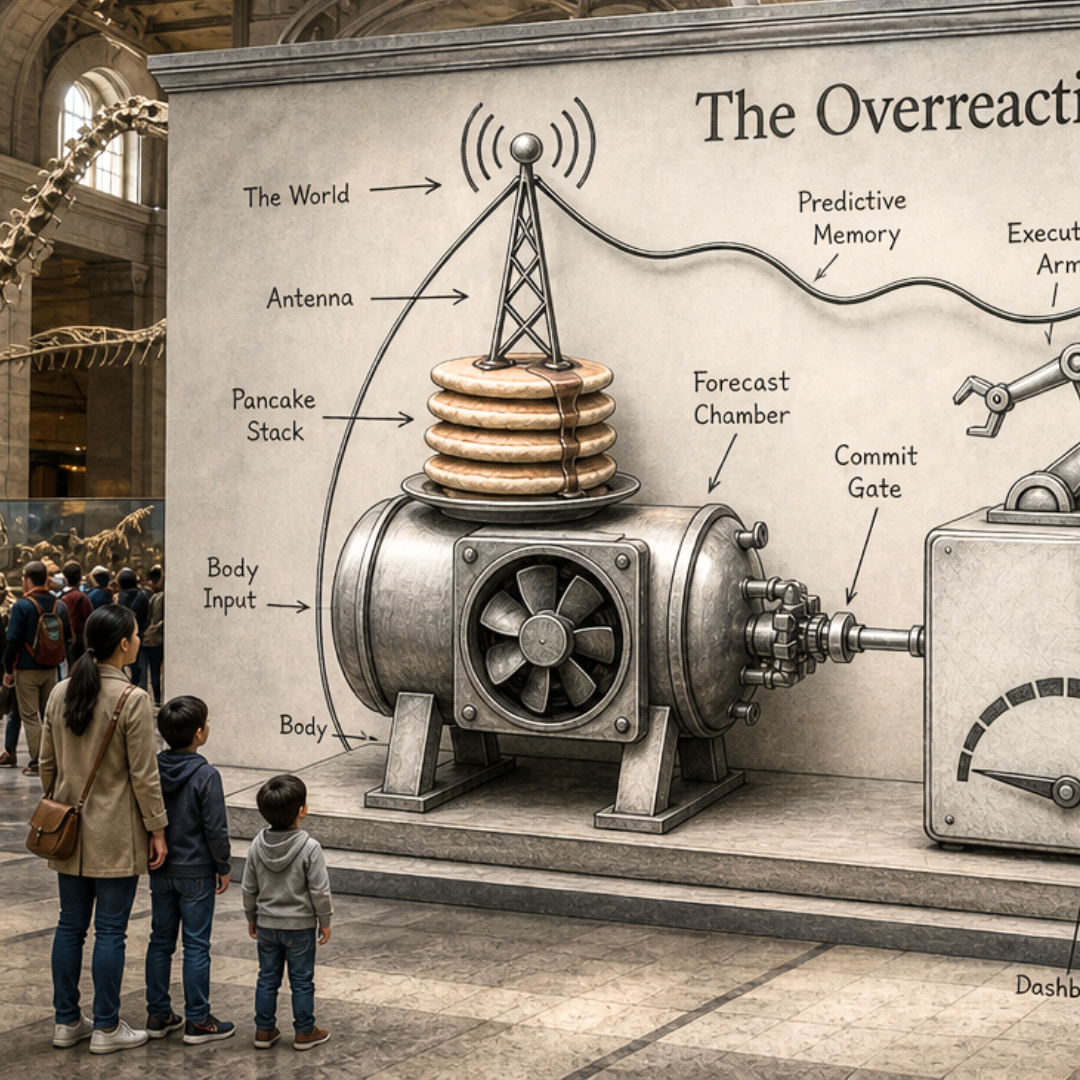
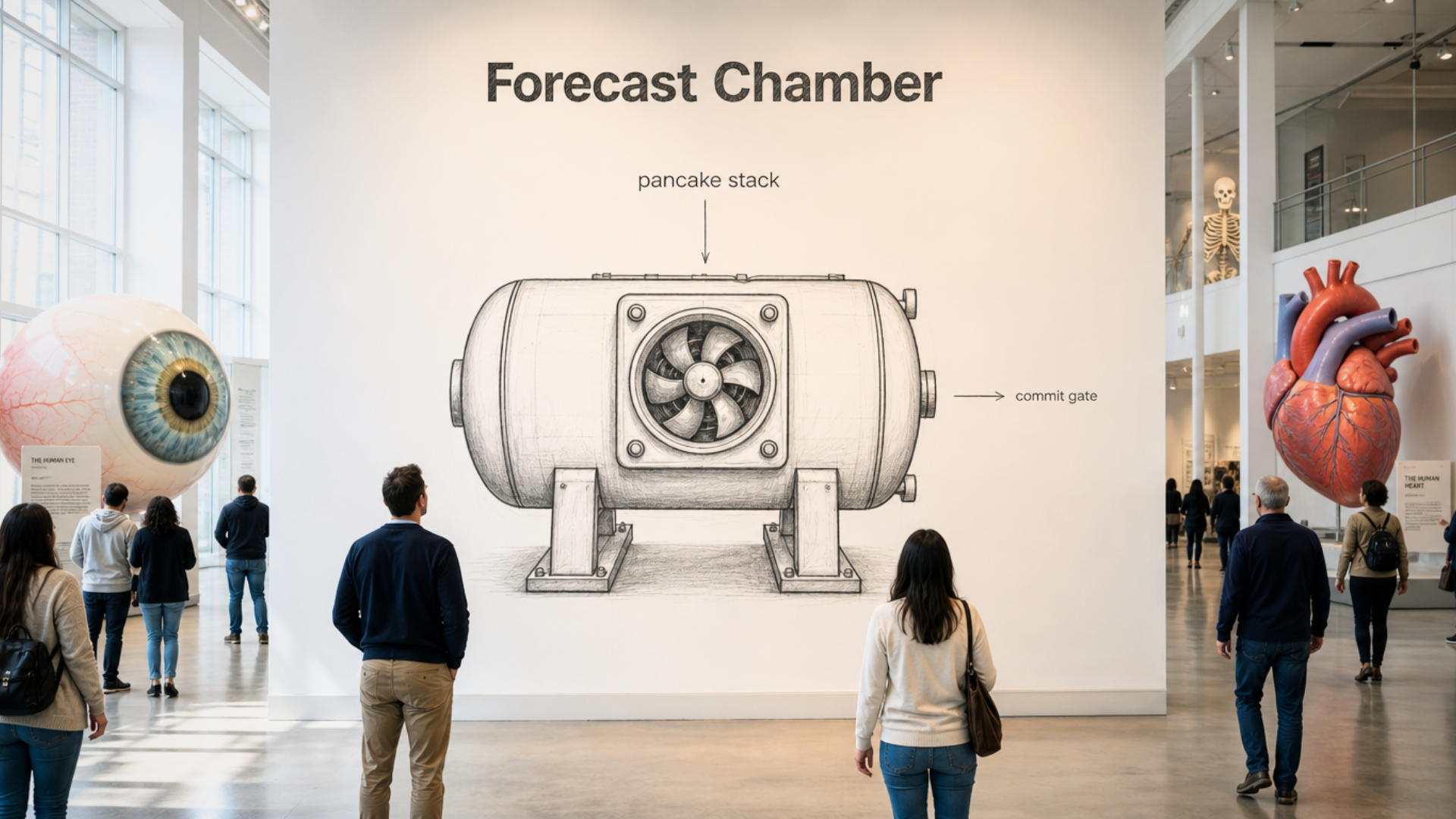
The Forecast Chamber is the future-simulation component of the Overreaction Machine. It generates possible future trajectories from the material handed down by the Pancake Stack.
The Antenna has already created a weighted incoming world.
The Pancake Stack has already determined which regulatory engine controls forecasting.
Now the Forecast Chamber takes that material and continues it forward.
This is happening.
becomes:
This could happen next.
Or this. Or this. Or, in some machines, approximately forty-seven additional things before breakfast.
These are branches: possible trajectories extending from the current situation into futures that do not yet exist.
The Forecast Chamber is where reality starts multiplying.
Where It Sits in the Machine
ANTENNA
What entered, and how strongly?
↓
PANCAKE STACK
Which regulatory engine controls forecasting?
↓
FORECAST CHAMBER
What could happen next?
↓
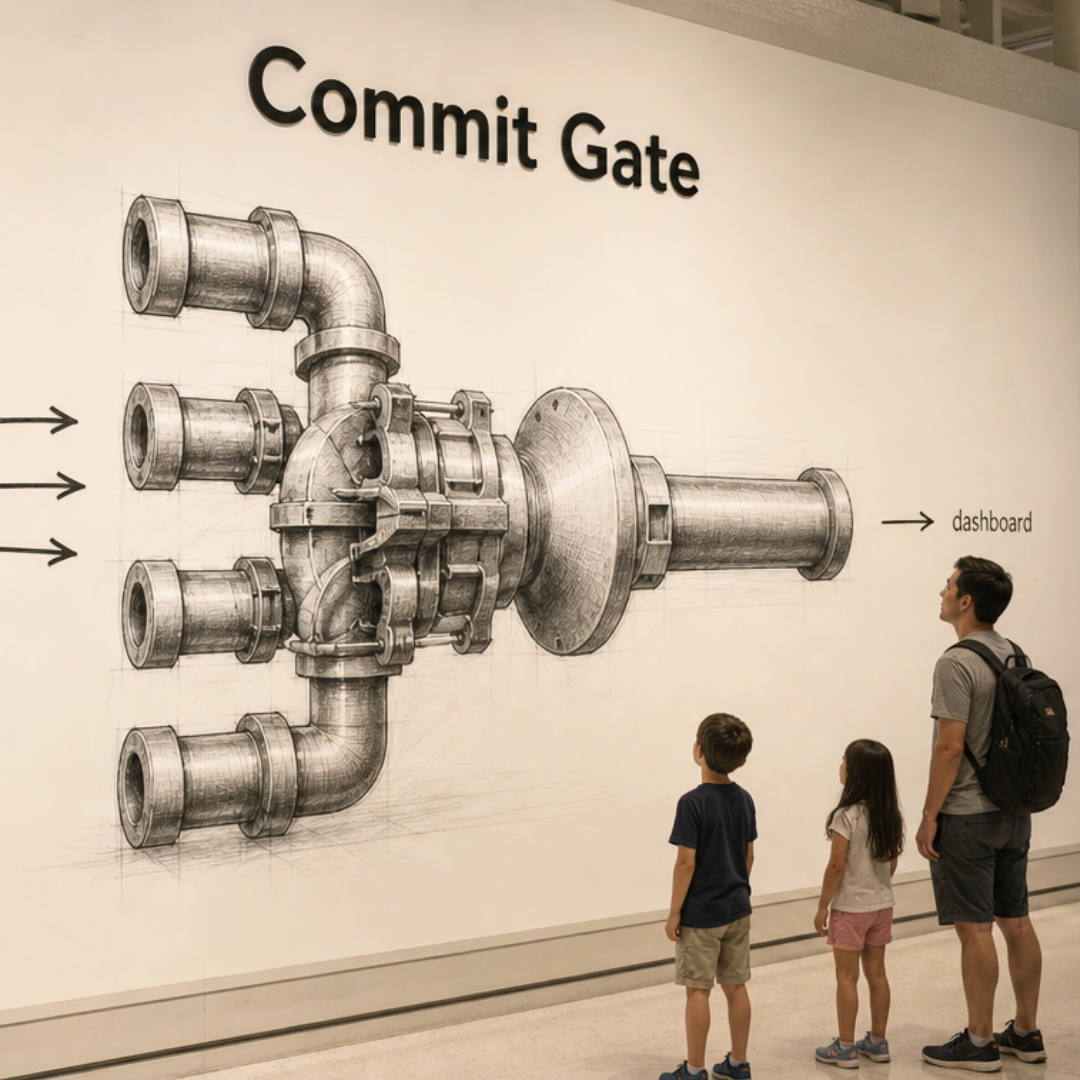
COMMIT GATE
Which trajectory becomes the working future?
The Forecast Chamber does not begin with raw reality.
By the time material reaches it, the Antenna has already weighted the incoming world and the Pancake Stack has already established the controlling regulatory objective.
The chamber then does something enormously useful and occasionally ridiculous: It moves forward before reality does.
What Is a Branch?
A branch is simply one possible future trajectory generated from the machine's current situation.
Suppose someone says:
We should probably talk about the budget.
One branch might be:
We spent too much this month → we'll cut back next month → problem solved.
Another:
We're spending too much → we can't sustain this → we'll have to make major changes.
Another:
They think I'm spending too much → this is actually going to be an argument about me.
Another:
Maybe we should finally build that spreadsheet.
All began with the same current reality. They did not necessarily begin with the same controlling pancake, the same predictive memory, the same Master Divide orientation, or the same Body State.
And once the Forecast Chamber starts running, they don't necessarily develop the same way either. That's where configuration enters.
Forecast Chamber Configuration
Every human has a Forecast Chamber. They do not all manufacture possibility the same way. For now, three differences appear to do most of the useful explanatory work.
Branch Generation
How readily and broadly are possible future trajectories generated?
Give two machines the same situation.
One produces:
A → B
Another produces:
A → B
A → C
A → D
A → E
A → Wait, what if F?
Some Forecast Chambers produce relatively narrow possibility spaces. Others produce broad ones. This matters far beyond worry.
High Branch Generation can supply possibilities for planning, invention, problem-solving, creativity, strategy, anticipation and imagination.
The machine does not specialize in catastrophe. It specializes in possibility.
Branch Depth
How far is a possible trajectory elaborated once it begins?
Generating a future is one thing. Continuing it is another.
One machine considers taking a new job:
I'd have to move.
End branch.
Another:
I'd have to move → we'd need somewhere to live → that would change the commute → which might change where my husband works → which might affect whether we buy a house → which would...
Same initial possibility with a much deeper branch.
Most Branch Depth is ordinary forward forecasting: one projected consequence leads to another. But branches can also become recursive. Instead of merely predicting what happens next, the machine begins predicting predictions:
If I say this, she'll think I mean that → then she'll probably respond this way → I'll know she thinks that → she'll notice that I know...
At some point the museum staff turns off the lights and goes home.
Recursion is therefore not another component or, for now, another configuration knob. It is one way a branch can acquire depth.
And depth can vary by domain. A machine may forecast abstract problems several layers deep while barely extending social predictions. Another may do precisely the reverse. The earlier classification work identified this domain-specificity as important even though we're now folding it into Branch Depth rather than keeping a separate setting.
Branch Persistence
How long do alternative trajectories remain active?
Some possibilities appear and disappear almost immediately.
Maybe I'll go out tonight. No. Gone.
Others linger.
Maybe I'll take the job. Maybe I'll stay. Maybe we'll move. Maybe we won't.
Tuesday becomes Wednesday, then next month. The futures are still there.
A machine can therefore have high Branch Generation but low Branch Persistence: many possibilities appear, but most disappear quickly.
Another can generate only a few branches and maintain them for a very long time. That's an important distinction.
How many futures appear is not the same as how long they stay.
Width. Depth. Time.
The easiest way to remember Forecast Chamber configuration may be to picture a branching path.
BRANCH GENERATION
Width
How many roads appear?
BRANCH DEPTH
Length
How far down the roads does the machine travel?
BRANCH PERSISTENCE
Time
How long do the roads remain available?
Two people can therefore begin with the same signal and end up occupying radically different possibility spaces.
One has two short roads that disappear quickly. Another has twelve roads extending halfway across the county, several of which have apparently been granted permanent zoning approval. Same component with a different configuration.
What the Forecast Chamber Does Not Do
The Forecast Chamber generates possibilities.
It does not decide which possibility is true. A forecast is not evidence.
It does not decide which trajectory will ultimately be chosen. That's downstream.
It does not determine what entered the machine. The Antenna already did that.
It does not decide which regulatory engine controls forecasting. The Pancake Stack already won that fight.
And generating a future does not mean the machine consciously believes that future will happen. That's important. A possibility can exist long enough to influence processing without becoming a declared belief.
What if they fire me?
doesn't necessarily mean:
I believe they are going to fire me.
The Forecast Chamber is allowed to manufacture candidates without endorsing its own merchandise.
The Present Can Change Before the Future Arrives
This is the strange part.
Return to:
Can we talk?
The message hasn't changed. No additional facts have arrived.
But once the Forecast Chamber generates:
They're upset with me. Something happened. They have bad news. They're leaving.
the present can begin to feel different. The three words that looked ordinary thirty seconds ago can suddenly look ominous. Reality hasn't moved, but the machine has. And that's not a malfunction.
Forecasting is enormously useful. It lets humans plan before problems arrive, prepare for danger, imagine opportunities, design things that don't exist, anticipate consequences, coordinate with other people and occasionally remember to bring an umbrella.
The peculiar feature is that the machine must begin operating before it knows which future is real. Most branches will never happen. The machine needs them anyway.
Why It's Called the Overreaction Machine
This is where the name finally earns its exhibit label.
The Overreaction Machine doesn't necessarily overreact because it reacts too strongly. It overreacts because it reacts too soon.
Reality provides a signal. The Forecast Chamber continues that signal into futures. Those futures begin participating in the machine before reality has established whether any of them will occur.
That's why a tiny signal can produce an enormous internal event.
A glance. A pause. An email subject line. A doctor's request for another test. A For Sale sign. A job opening. Three words on a phone.
The signal can be remarkably small. The future is where the machine gets ambitious.
The Important Consequence
We often describe people as:
creative, anxious, indecisive, imaginative, overthinking, strategic, a worrier
But those are descriptions of visible patterns. Now we open the machine.
Someone who appears to “overthink” might have high Branch Generation or unusual Branch Depth or long Branch Persistence or some combination.
Someone who appears wonderfully spontaneous in one domain may generate almost no competing branches there while running an enormous possibility tree somewhere else.
The useful question isn't:
What kind of person is this?
It's:
What is their Forecast Chamber doing?
Because before someone can choose among futures, worry about futures, pursue futures, avoid futures, or build a life around one of them — the futures have to exist.
And fortunately, we have a chamber for that.
Explore MindStretched
Once you can see the machinery, human weirdness stops looking quite so mysterious.