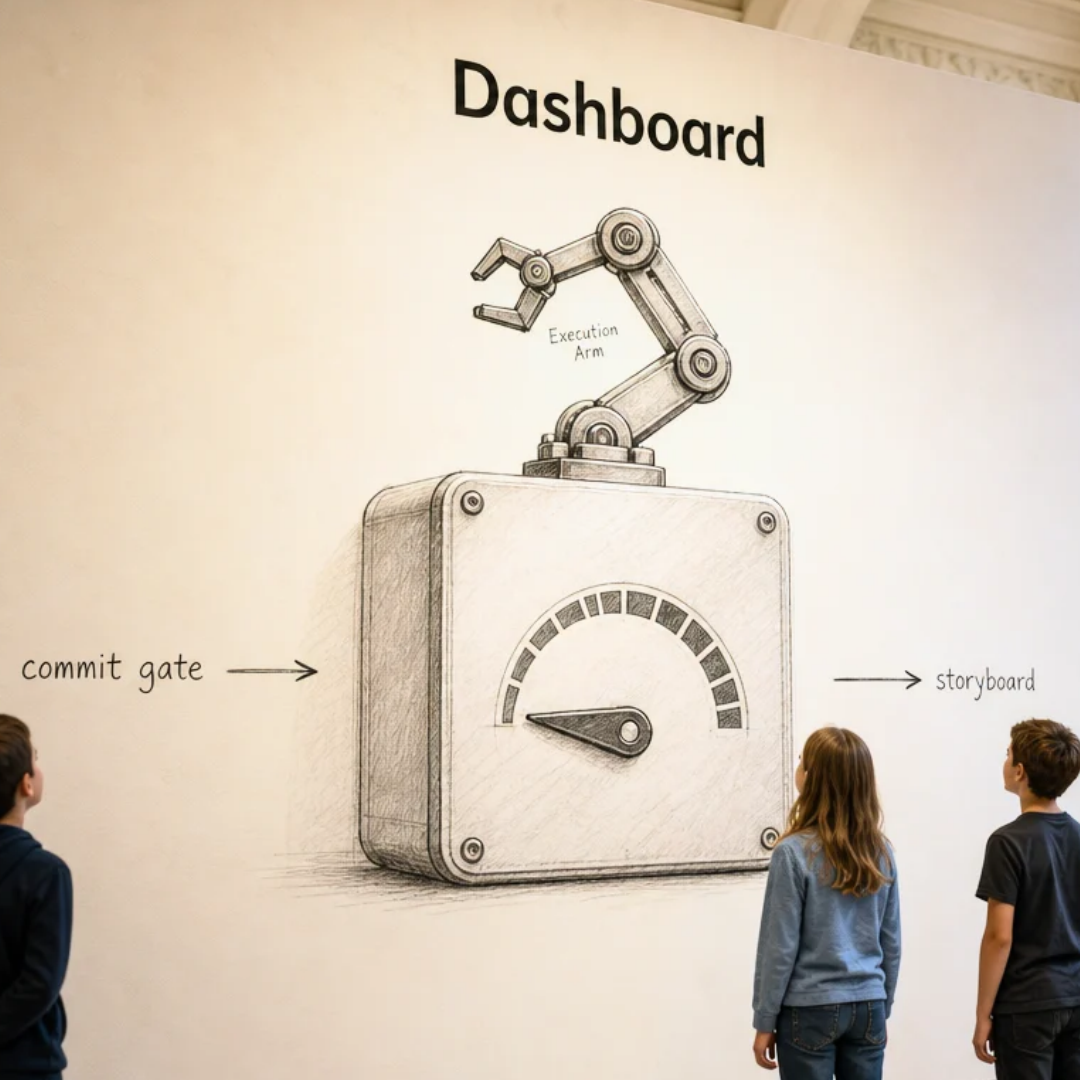
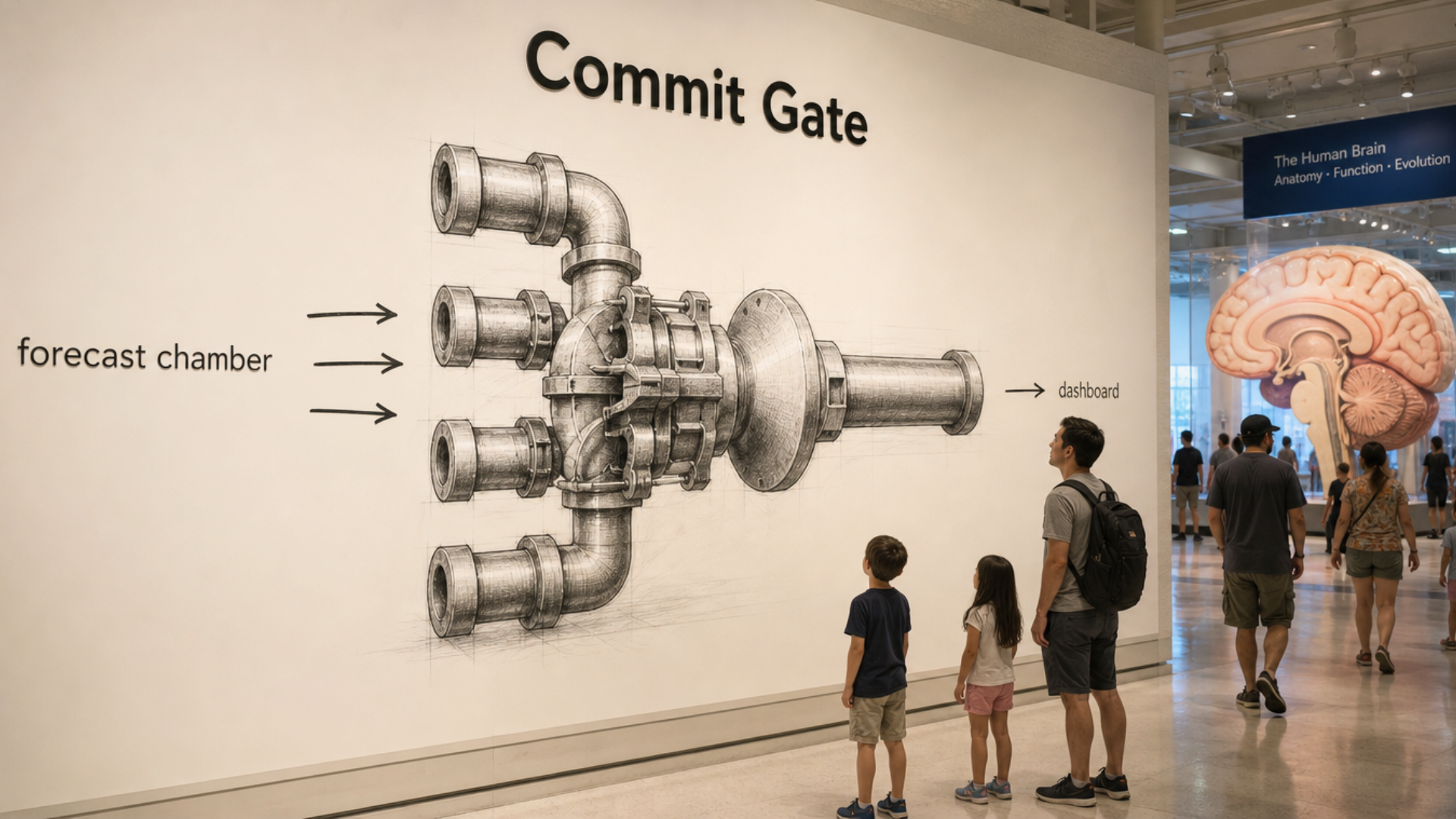
COMMIT GATE
When Possibility Becomes a Plan
The Forecast Chamber has been busy.
You could stay or you could leave or you could wait six months. You could ask for more money or take the other job or move to Portugal. There are now several perfectly serviceable futures wandering around the machine.
Unfortunately, you can only live in one of them. At some point, possibility has to become commitment.
Welcome to the Commit Gate.
What Is the Commit Gate?
The Commit Gate is the component of the Overreaction Machine that collapses multiple viable future trajectories into one committed trajectory.
Upstream, the Forecast Chamber can maintain alternatives. At the Gate, alternatives become actionably unequal. One trajectory eventually gains enough advantage for the machine to commit.
Click.
The gate closes and one future proceeds downstream. The others don't.
This is the point where:
I could...
becomes:
I'm going to...
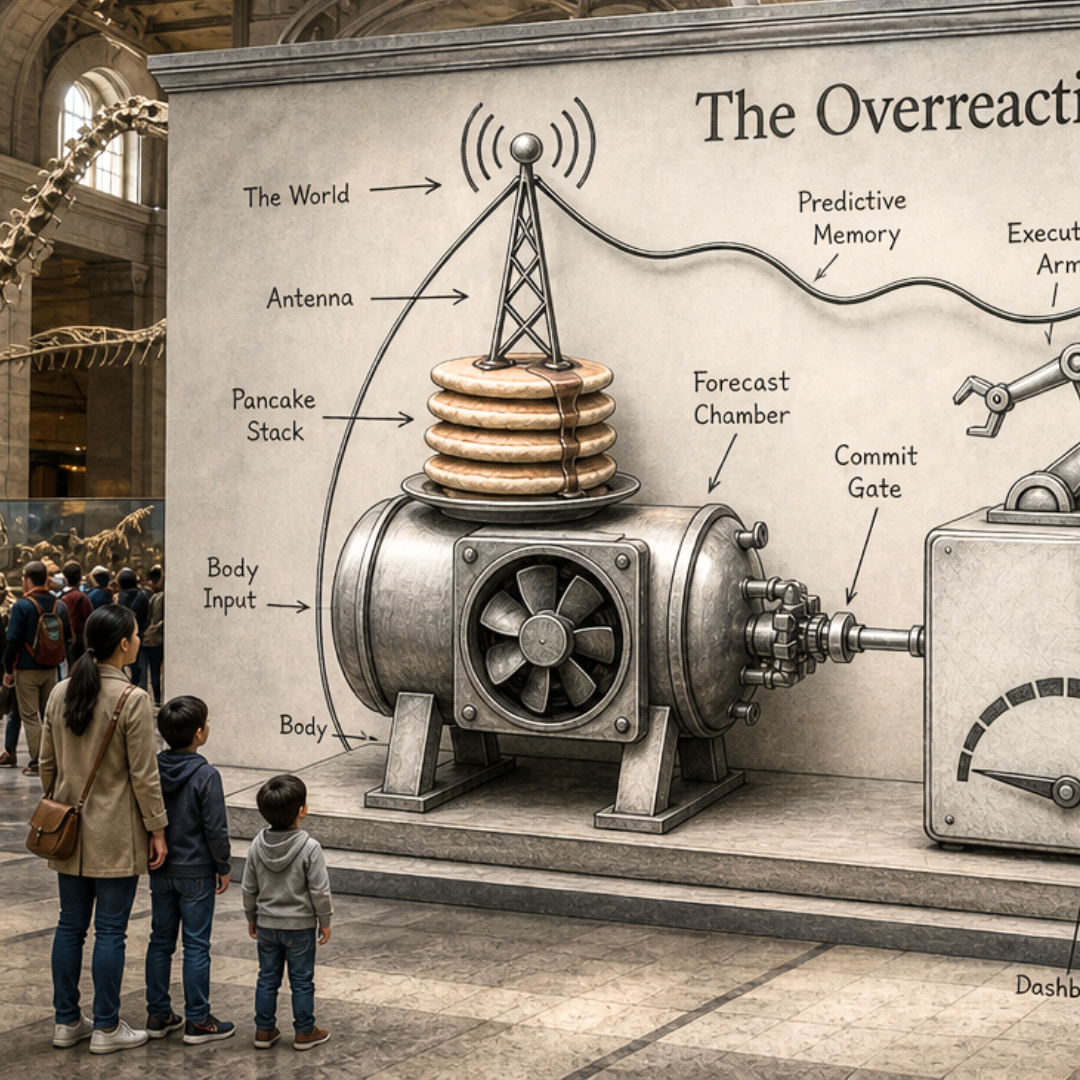
Where It Sits in the Machine
FORECAST CHAMBER
What could happen next?
↓
TRUE COST
What would each future cost this machine?
↓
COMMIT GATE
Is one future affordable enough to commit to?
↓
COMMITTED TRAJECTORY
↓
DASHBOARD
There is one important correction to that picture:
True Cost isn't actually another component sitting between the Forecast Chamber and Commit Gate. It's the comparison metric the Gate operates on.
Think of the possible futures arriving at the Gate with their projected costs attached. The Gate uses those costs to determine when one trajectory has gained sufficient advantage to become the machine's committed future. Which means we need to inspect the price tags.
TRUE COST
The Price the Whole Machine Pays
Humans are quite good at explaining what they want.
I want the promotion.
I want to leave.
I want to exercise.
I want to tell them what I really think.
I want to start the company.
This is useful information, but not the calculation. A future can be consciously desirable and still carry enormous projected costs elsewhere in the machine.
Take the promotion.
Future A: Accept it.
You get more money and also more responsibility, less free time, greater visibility, possible failure. You also get different relationships with coworkers, a move, loss of a familiar routine, more status, less autonomy, and a very annoying commute.
Future B: Stay where you are.
You get less money, less advancement, familiar work, known expectations, existing relationships, no move, more free time, and possible future regret.
The machine doesn't encounter one benefit and one cost. It encounters whole projected futures. True Cost is our name for the total projected burden associated with operating each one.
True Cost Is Personal
There is no universal price list. The same future can be cheap for one machine and spectacularly expensive for another.
Consider:
Move across the country for a better job.
For one machine, the move offers autonomy, novelty, opportunity and a better fit. Cheap enough.
For another, the exact same move means leaving family, losing predictable routines, rebuilding a social world and surrendering a familiar environment. Expensive.
Same job, same salary, same city.
Different machine, different True Cost.
This is why knowing the objective facts of a choice doesn't necessarily tell you why someone chose what they chose. You still need to know which machine was paying the bill.
True Cost Is Projected
This part matters. The machine isn't comparing what the futures will actually cost. It can't because they haven't happened yet. It is comparing what it predicts they will cost. And predictions can be excellent or terrible.
A machine may predict that speaking up will destroy a relationship.
It may predict that changing careers will be unbearable. It may predict that staying will be safer. It may predict that leaving will finally solve everything. But, those forecasts can be wrong.
The Gate still has to operate on the information available to the machine at the time.
Which gives us an important distinction:
Lowest True Cost does not mean objectively best future.
It means the future currently projected to be most affordable to this machine. The future may later prove expensive. Reality retains the right to send an invoice.
The Gate Doesn't Ask What You Want
This is one of the more useful things about the Commit Gate.
Imagine someone repeatedly says:
I really want to leave this job.
And they don't leave.
The usual explanations arrive immediately. They're lazy or afraid or lack willpower. They don't really want it.
Perhaps. But open the machine first.
The Forecast Chamber may contain:
LEAVE
and
STAY
The person may consciously prefer LEAVE.
But once the machine forecasts lost income, uncertainty, interviews, possible failure, disrupted routines, social consequences, identity consequences and six months of not knowing what happens next, LEAVE may still carry the higher True Cost.
So the Gate commits again to:
STAY.
Not because staying is wonderful, but because among the currently available futures, it remains cheaper.
This is the central True Cost claim:
You don't necessarily live the future you prefer. You tend to live the future your machine can most afford.
COMMITMENT THRESHOLD
This is the Commit Gate's major configuration setting.
How much comparative advantage does one trajectory need before the machine commits to it?
Even when one future becomes cheaper than the others, machines don't necessarily commit at the same point.
Imagine three futures:
A — True Cost: 42
B — True Cost: 45
C — True Cost: 51
One machine looks at that difference and:
CLICK.
A wins.
Another machine: Absolutely not. Those are practically tied. The possibilities remain active and more information arrives. The machine runs forward again.
Now:
A — 31
B — 47
C — 56
CLICK.
Same eventual commitment but a different amount of uncertainty required before the Gate would close.
THE CLOSURE THRESHOLD LAW
This difference is important enough to have its own law.
Human systems differ in how much unresolved uncertainty they tolerate before collapsing possibility into commitment.
Some machines close with relatively little separation between competing futures. Others require much greater separation.
That difference can show up everywhere. Choosing a restaurant, buying a house, deciding what someone meant, selecting a diagnosis, ending a relationship, forming a belief, publishing a theory.
One machine reaches sufficient comparative advantage quickly while another keeps alternatives alive. Neither behavior requires a character explanation. Sometimes you're simply looking at different closure thresholds.
Fast Closure Is Not Certainty
This is where human language causes trouble. Once someone commits, we often assume they must have been extremely certain. Not necessarily.
A low-threshold Gate doesn't require overwhelming certainty. It requires enough advantage to cross that machine's threshold.
Likewise, someone who keeps considering alternatives isn't necessarily confused or indecisive. Their Gate may simply require greater separation before commitment.
This produces a peculiar social situation:
One person says:
Obviously A.
The other says:
How can you possibly know that yet?
Both may have seen essentially the same evidence. Their gates just clicked at different distances.
The Machine Does Not Go Backward
Suppose the Gate commits:
I'm taking the job.
Two weeks later, new information arrives. The company is having financial trouble.
Now the person decides:
I'm not taking it.
The old Commit Gate did not reopen. The machine did not reverse through its gears and retrieve Future B from a previous cycle.
New information entered the Antenna. Then the machine ran forward again. The Forecast Chamber generated the futures available now. Their projected True Costs changed and the Commit Gate made a new commitment.
This is important throughout the Overreaction Machine:
The machine moves forward.
What happened before becomes material for what happens next. It doesn't become a tunnel back into the previous run.
What the Commit Gate Does Not Do
The Commit Gate does not generate futures. The Forecast Chamber already did that.
It doesn't decide what matters globally to the machine. Configuration already exists.
It doesn't invent True Cost. True Cost emerges from the projected consequences of the available trajectories as processed by this particular machine.
It does not guarantee that the selected future will work. It can't inspect reality from next Thursday.
And it does not explain afterward why the machine committed. The Storyboard will be delighted to handle that assignment later.
The Gate has one job:
When one viable future has sufficient True Cost advantage, commit.
Click.
Next department.
The Important Consequence
By the time behavior becomes visible, an enormous amount has already happened.
The Antenna created a weighted incoming world.
The Pancake Stack established regulatory control.
The Forecast Chamber generated possible futures.
Those futures developed projected consequences.
True Cost made them unequal.
And the Commit Gate waited until one had enough advantage to cross this machine's Commitment Threshold.
Only then did possibility become commitment.
Which means that when someone says, Why did you choose that? the answer may not be sitting inside the choice itself. You have to inspect the futures that were available and what they cost the machine that had to live in them.
Because the Gate doesn't choose the perfect future. It doesn't even choose the future someone likes best. It commits to the future the machine can afford.
Explore MindStretched
Once you can see the machinery, human choice stops looking quite so weird.