STORYBOARD
The Story We Keep
Something happens, you notice things, you predict things, and several futures appear. You hesitate, then one future becomes cheaper and you commit and act. Conditions change while you're acting, so your response changes with them.
It is, mechanically speaking, a mess. Fortunately, the human machine has absolutely no intention of storing all that because it much prefers a story.
Welcome to the Storyboard.
What Is the Storyboard?
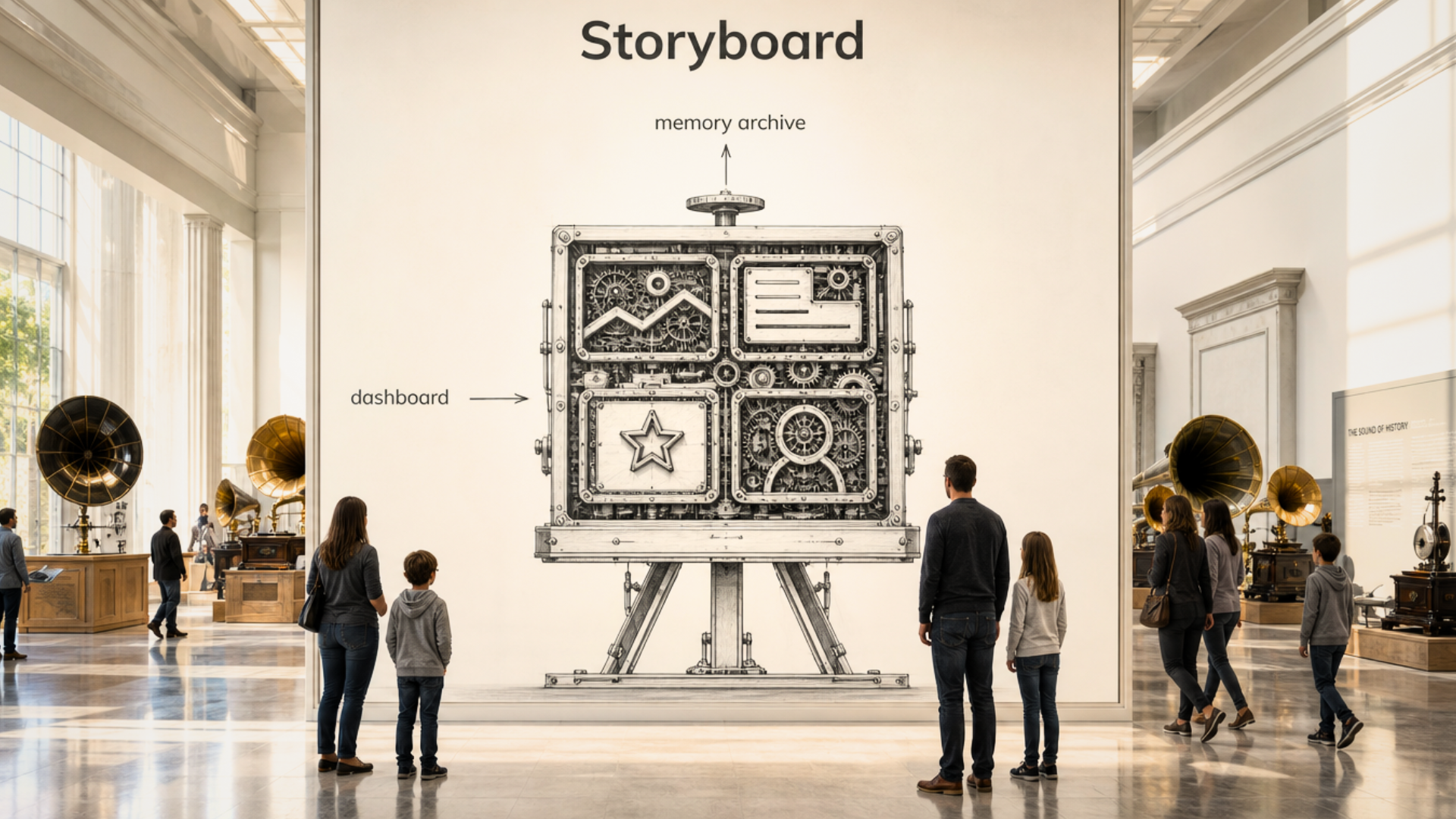
The Storyboard is the component of the Overreaction Machine that compresses a messy lived trajectory into a coherent representation suitable for storage.
The actual event may contain competing forecasts, changing conditions, contradictory motives, abandoned alternatives, uncertainty, hesitation and information that arrived halfway through.
The Storyboard takes all of that and produces something considerably more manageable.
I did it because ______.
It's clean, coherent, storable. Not necessarily false, but definitely not the event itself.
The Storyboard's job is Narrative Coherence Compression: turning the complicated trajectory the machine actually traveled into a simpler representation it can carry forward.
Where It Sits in the Machine
COMMIT GATE
One trajectory is committed.
↓
DASHBOARD + EXECUTION
The trajectory is carried out.
↓
STORYBOARD
What happened here?
↓
MEMORY ARCHIVE
Keep this for later.
That's the clean teaching sequence. But, the Storyboard doesn't necessarily sit around doing nothing until the event is completely over. It can begin organizing the trajectory as events unfold, then consolidate the completed experience into the representation that moves into Memory Archive.
So the Storyboard isn't merely the machine's press secretary arriving three hours later. Compression can happen along the way.
Reality Is Too Large
Suppose someone invites you to a party.
The actual trajectory looks something like this:
I don't really want to go.
But I haven't seen them in months.
Maybe it would be fun.
I could stay home.
She'll probably be disappointed if I don't go.
I'm tired.
Fine. I'll go for an hour.
You arrive and someone you like is there so you end up staying three hours. You have a great time.
Later someone asks:
Why did you go?
And out comes:
I wanted to see everyone.
Perfectly plausible, but nowhere near a complete mechanical record of what happened.
The competing trajectories as well as changing cost landscapes are gone. The hesitation is gone. All the information that arrived during execution has been folded into one clean explanation.
The Storyboard has done its job.
Compression Is Not Replay
This distinction matters. The Storyboard is not a little security camera recording the machinery exactly as it happened. It is constructing a compressed representation. And, compression necessarily loses information.
Imagine trying to store every signal, every forecast branch, every change in projected cost, every Dashboard movement, every abandoned possibility and every micro-adjustment made during execution. Congratulations, you have successfully remembered Tuesday. And, storage will now require a warehouse.
Instead, the Storyboard reduces the event to something usable. That usefulness comes at a price:
The compressed version is not identical to the original trajectory.
How the Story Gets Cleaner
Our current model identifies five common compression operations.
Soften Contradiction
The actual event:
I wanted to go.
I didn't want to go.
I almost cancelled.
Then I went.
The Storyboard:
I decided to go.
Competing states become one coherent trajectory, which is very considerate of the storyboard.
Relabel Motive
Behavior rarely emerges from one neat conscious reason although explanations greatly prefer one. A complicated trajectory involving social cost, fatigue, obligation, anticipated enjoyment and uncertainty can become:
I went because I wanted to support her.
Maybe support really mattered. The Storyboard simply neglected to attach the remaining seventeen pages.
Reorder Sequence
Actual processing unfolds over time. Information arrives, then forecasts change, and costs change. Commitment happens. Execution changes the environment. Then more information arrives.
But the final story can make the ending appear to have been present from the beginning:
I knew I was going to do it.
Perhaps, but the machinery has misplaced several minutes of footage for sure.
Inflate Inevitability
Once something happened, the alternatives that almost happened can become surprisingly difficult to see.
Before:
A might happen.
B might happen.
C might happen.
After C:
Of course C happened.
Yesterday's possibility tree has become today's straight line.
Downgrade Alternatives
The branches that lost don't need much space in the final representation.
I could have taken the other job, but it wasn't really right for me.
Maybe. Three weeks earlier the machine maintained that branch so vigorously that it produced a spreadsheet. Storyboard has since revised its historical importance.
Storyboard Configuration
Every machine compresses experience. They don't necessarily compress it to the same degree or in the same way. For now, two configuration differences earn their place.
Narrative Consolidation
How strongly does the machine compress a messy experience into one unified explanation?
High Narrative Consolidation produces relatively clean, coherent representations.
This happened because X.
Lower consolidation can preserve more ambiguity, contradiction or multiple explanations.
It was partly X, maybe Y, and honestly Z probably mattered too.
Neither representation gives us direct access to the machinery. One is simply more consolidated than the other.
Reconstruction Bias
How strongly and systematically does compression reshape the original trajectory?
All compression changes representation because information has to be selected, reduced and organized. But machines may differ in how much reconstruction occurs during that process.
Contradictions may disappear more strongly and motives may become cleaner. Sequence may become smoother while alternatives may shrink more dramatically.
The important word is reconstruction. The Storyboard isn't retrieving a finished explanation that was sitting inside the event waiting to be discovered. It is building one.
The Storyboard Is Not a Lie Detector
This deserves its own display case.
If someone's explanation is a compressed reconstruction, that does not mean:
They're lying.
Lying requires something additional: representing something one way while knowingly communicating it another way. The Storyboard doesn't require deception at all, it compresses on purpose.
The person may sincerely report:
I left because I knew it wasn't right for me.
That may be the representation currently available to them. The mistake is not necessarily theirs.
The mistake is ours, if we treat that representation as a literal recording of the machinery that produced the behavior.
Mechanology doesn't need to accuse the witness. It just doesn't let the witness dismantle the machine.
The Storyboard Does Not Cause the Behavior It Explains
This may be the most important boundary on the page.
Someone says:
I didn't speak up because I'm not confrontational.
It is tempting to put:
NOT CONFRONTATIONAL
at the beginning of the machine and declare the investigation complete.
But that explanation is Storyboard output. The actual machinery occurred upstream.
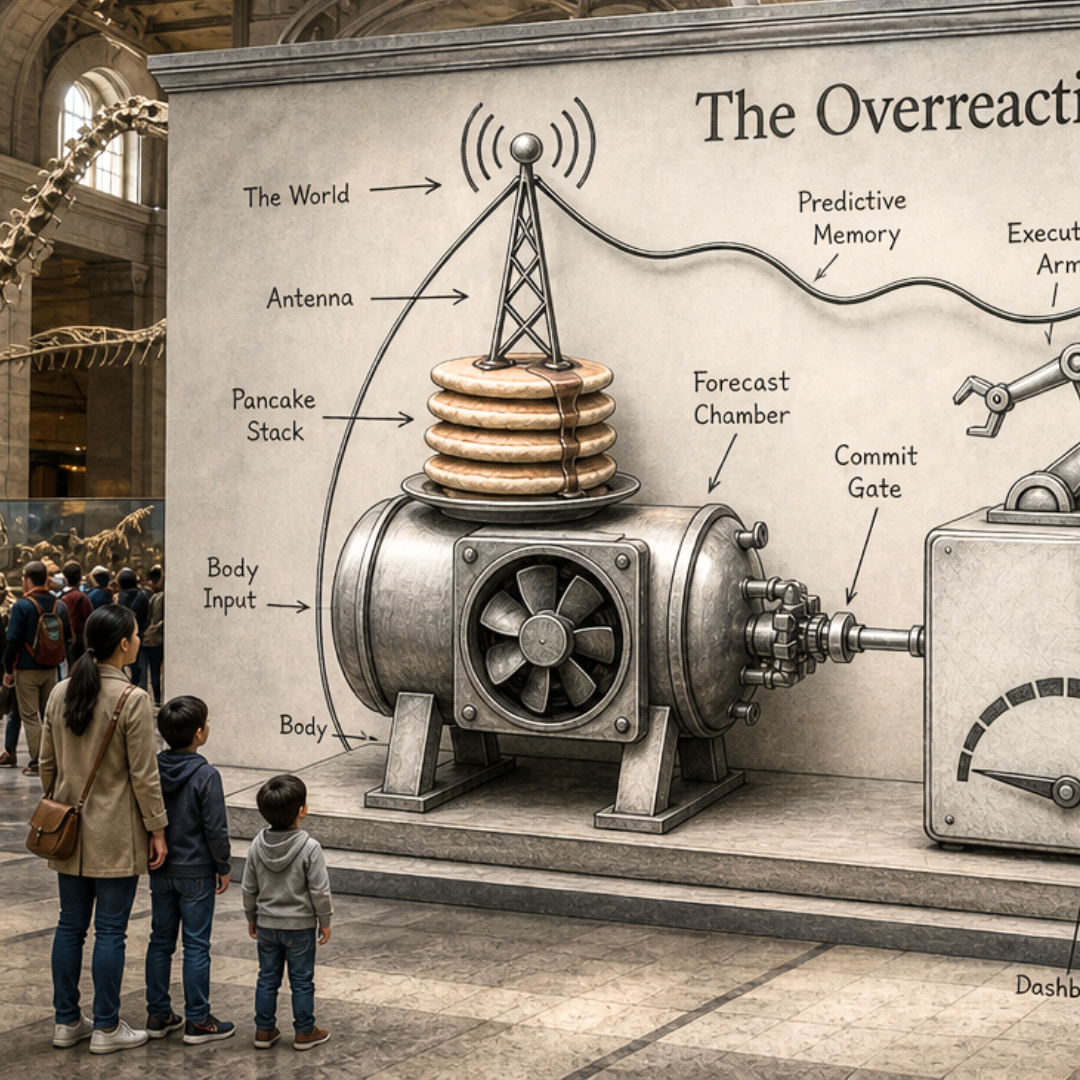
What entered through Antenna?
Which pancake controlled forecasting?
What futures were generated?
What were their True Costs?
Which trajectory crossed the Commit Gate?
What happened at the Dashboard?
Only after all of that do we get the clean explanation:
I'm just not confrontational.
The label may summarize a recurring pattern beautifully. It still isn't necessarily the mechanism that produced today's silence.
Storyboard output should not be mistaken for machine input.
Explanation Is Not Source Code
This is why asking humans why they did something can be useful without treating the answer as mechanical truth.
Why did you buy the house?
Because we loved the neighborhood.
Why did you quit?
Because I was ready for something new.
Why didn't you call?
Because I needed space.
Those answers contain information. They may capture important parts of the trajectory. But they arrive after compression.
You're not receiving a printout from the Commit Gate, the part that calculated True Cost. You're receiving the Storyboard answer.
This is one reason two sincere explanations of the same event can change over time without requiring anyone to have been dishonest.
The representation itself can be reconstructed again as new information enters future machine cycles and Memory Archive supplies different material. The archive keeps receipts. It does not promise to keep the original filing system.
What the Storyboard Does Not Do
The Storyboard does not select behavior. Commitment already happened upstream.
It doesn't determine True Cost.
It doesn't choose which pancake controls forecasting.
It doesn't preserve a perfect recording of experience.
It doesn't prove someone's explanation is false.
And it doesn't need a special Explanation Persistence setting.
Once a representation has been consolidated and stored, questions such as how readily it is retrieved, how easily it updates, how broadly it generalizes and how long its influence persists belong downstream in Memory Archive.
Storyboard builds the file. Memory Archive gets stuck managing it.
The Important Consequence
Humans constantly explain humans with Storyboard output.
She's generous. He's insecure. I'm independent. She hates conflict. He's lazy. I'm just an overthinker. They don't respect me. I stayed because I loved him. I left because I finally knew my worth.
Some of those descriptions may be useful. Some may be accurate summaries, but a summary is not a mechanism. And, a mechanism is the only cause.
The Overreaction Machine asks us to make one more move:
Where did that explanation come from?
Because the explanation itself is an artifact produced by machinery.
And once you know the Storyboard exists, “because that's why I did it” stops being the end of the investigation.
Explore MindStretched
Once you can see the machinery, human weirdness stops looking quite so mysterious.