I've never understood people
Not because people are irrational (although they often seem to be). But, because common explanations never seemed to explain very much.
Before MindStretched I was an optometrist, which means I learned biology. Then, after raising three kids I became a science teacher. My favorite part of the year, by far, was the science fair. Students would have an idea, test it, and discover it didn't work. Nobody thought the students had failed. The hypothesis had been proven untrue, that's all. Good to know.
Most people don't stop there though. They say, "I'm such a failure." I say, "No, you're not. What you tried didn't work. There's a huge difference."
Years later I went to life coach school because I thought psychology might finally explain why people do what they do. Instead, I kept running into teachings like, "Change your thoughts." "Your thoughts create your reality." The idea wasn't necessarily bad, it just wasn't an explanation that worked for most people. Same for my years learning Stoicism.
People understood the advice, even agreed with the advice. Then they went home and did exactly what they'd been doing before, even if what they were doing caused a lot of pain. If understanding something and trying as hard as you can isn't enough to change it, then the explanation is missing something.
Finally, a friend told me the future is fixed, it's physics. I told him he was crazy, but I dove in anyway (curiosity, you know) . Not because I suddenly thought physics explained people, but because physics explains something I've always trusted, scientific laws.
Water doesn't decide whether to boil and a bridge doesn't choose whether to collapse, physical systems just behave according to the laws governing them. That raised a different question, What if people do too? Because, you know, we're absolutely physical systems. That's basically what I've been working on ever since.
Physics, evolutionary biology, cognitive and computational neuroscience, game theory, predictive processing, learning theory, computational modeling... it's all starting to fit together into one framework. This is my functional model of how a human gets from what happens to what they do next.
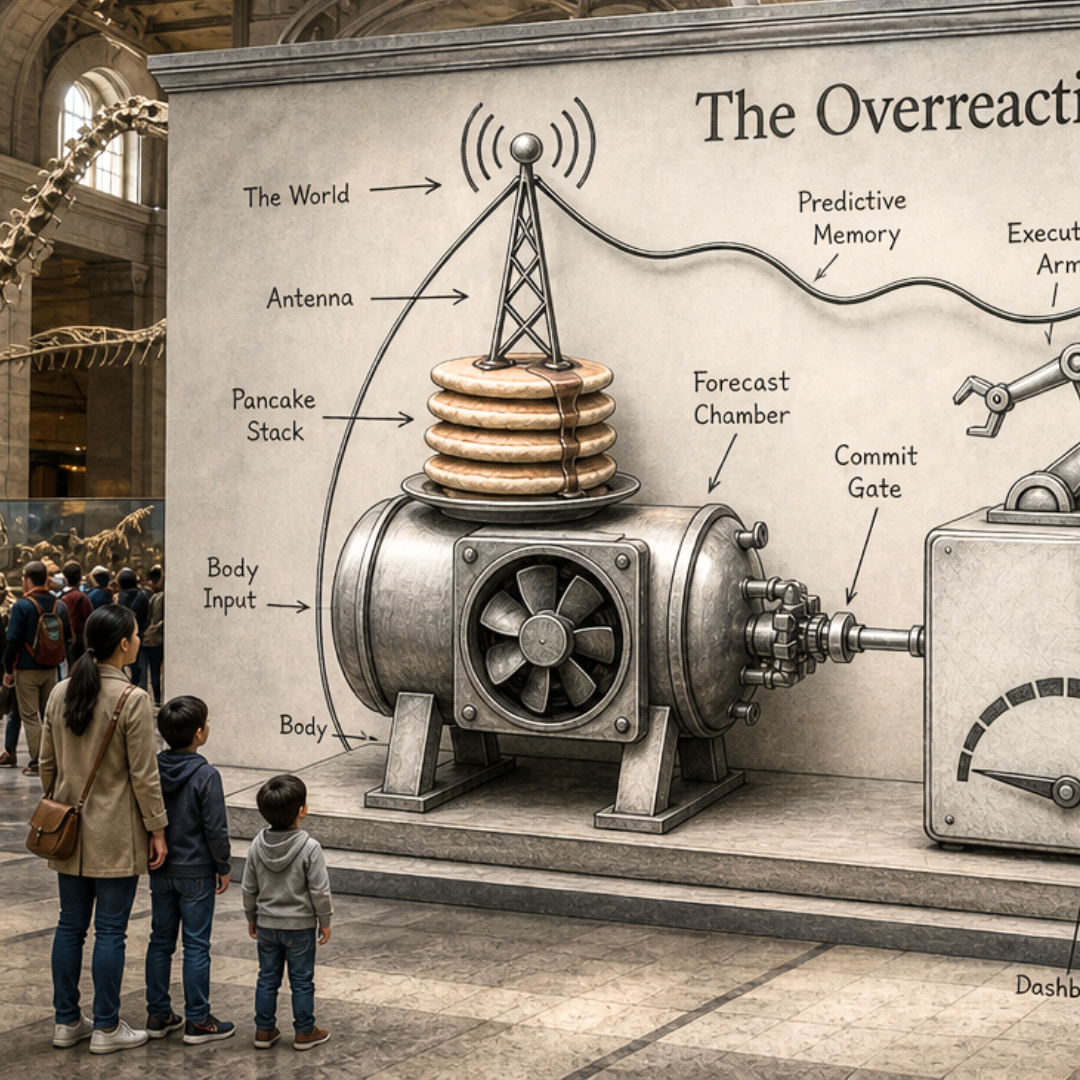
The Overreaction Machine takes ideas from contemporary research about how humans perceive, predict, learn, remember and choose, then turns them into a simple architecture for exploring everyday behavior. Its parts are metaphors. Its purpose isn't to tell you about what is literally happening inside a brain (we'll leave that to the neuroscientists). The machine is made to give you a better answer to the question, “What's wrong with that person?” or even more devastating, "What's wrong with me?"
And, once you put humans together, it's amazing how the machines create teams and governments and religions and ways to deal with other humans. Civilization is the output of the what happens when Overreaction Machines have to work with one another.
MindStretched and the Machine were developed by yours truly, although AI has been my very close partner in research, debating the way humans act, and in building this ridiculous imaginary museum.
Stick around a while. I'm investigating one human problem at a time. This is where we both find out what's really going on behind the scenes.
Lani
Explore MindStretched
Once you can see the machinery, human choice stops looking quite so weird.