
Why does every school shooting start the same argument?
A mass shooting happens. Columbine. Sandy Hook. Parkland. Uvalde. Different schools, different shooters, different circumstances, and afterward the same enormous national argument about what happened, why it keeps happening and what in the world we're supposed to do about it.
So let's try something that should fix the argument, let's give everybody the facts. Not some of the facts, all of them. Same information about what happened, the person who did it, the guns that were used, how they were obtained, the victims, the police response, gun ownership, gun deaths, defensive gun use, other countries, previous shootings, existing laws, proposed laws. Nobody gets a different news channel or a misleading statistic or a Facebook post from their cousin who did his own research.
For once, everybody gets the same giant packet of completely accurate information. There, surely we've fixed America.
Except we haven't, because two people can read the entire packet, agree that everything in it is true, and walk away having detected two different problems.
One Machine might look across shootings, gun deaths and countries with far fewer guns and detect a fairly obvious repeating feature, guns. Another might look across shootings and detect disturbed or violent people, failures to intervene, failures in school security, cultural changes, family breakdown or something else entirely. Neither person has to pretend the other facts aren't sitting there. Their machines just haven't given those facts the same importance.
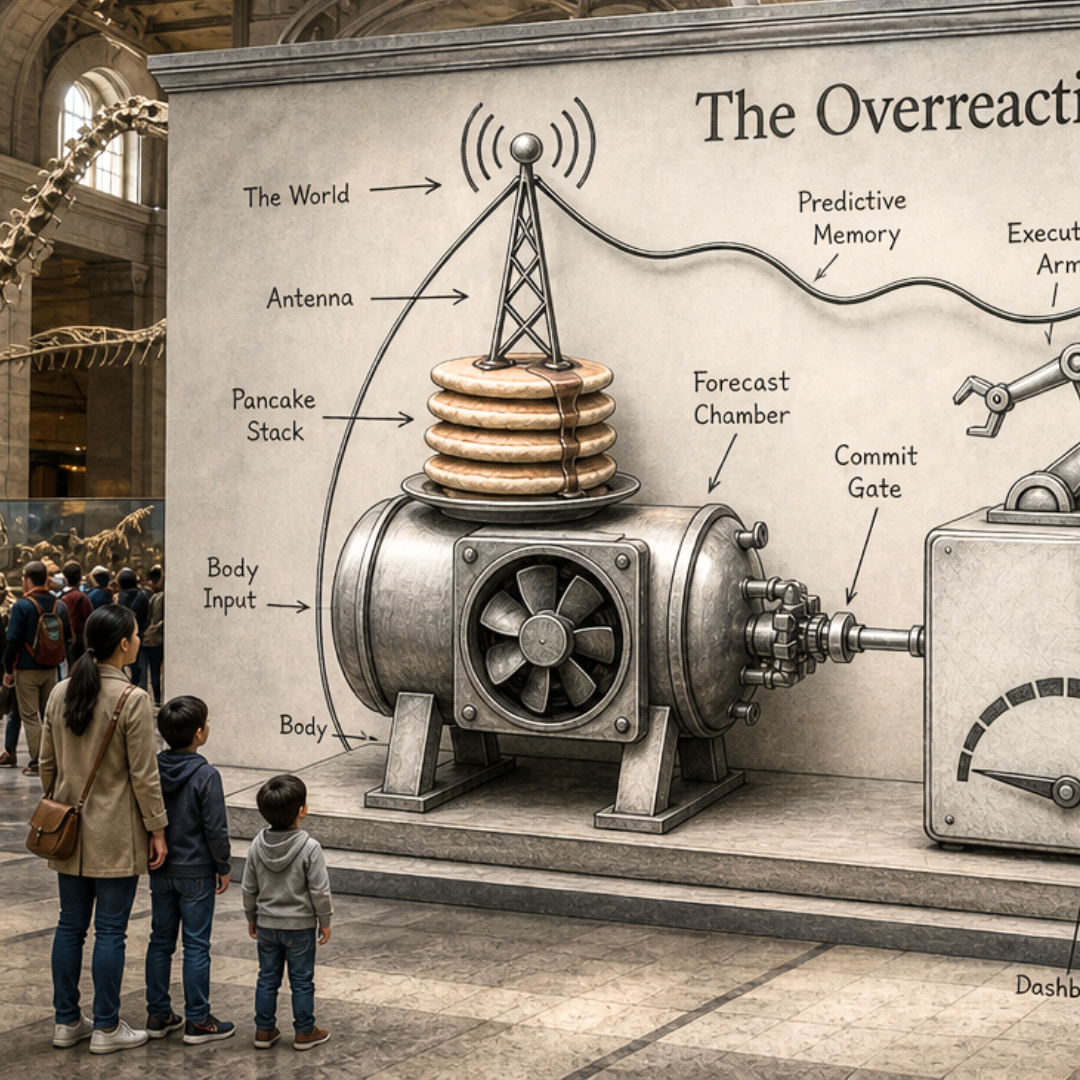
Which brings us to pancakes. The Overreaction Machine doesn't have one tiny objective scientist inside who receives Facts, spreads them evenly across a table and announces what they mean. It has four regulatory engines (Survival, Pattern, Social and Logic) competing over what matters most right now. We call this the Pancake Stack, partly because the engines stack in different priority orders and partly because nobody was going to remember Four Competing Regulatory Engines.
Pattern is particularly vigilant here. Its job is to connect what's happening now with what the Machine already knows. So one Pattern engine can look across mass shootings, gun deaths, gun availability and other countries and say, Well, there seems to be a gun-shaped thing happening here.
Another Pattern engine can look across many of the same shootings and say, There seems to be a human-shaped thing happening here. Why are people doing this? What happened before the shooting? Who knew something was wrong? Why didn't anyone intervene?
Both can keep reading the packet. This is the part we tend to miss when we say people need more facts. More facts about what?
If one Machine has detected widespread access to guns as the problem, another example of a responsible gun owner doesn't answer the question it is asking. Of course responsible gun owners exist. That wasn't the problem.
If another Machine has detected violent humans as the problem, another statistic about gun ownership may not answer its question either. Fine, there are guns. Why did this particular human decide to walk into a school and murder people?
Survival doesn't rescue us. One Machine represents the central danger as an armed person being able to kill other people and sees reducing access to weapons as reducing that threat. Another represents the central danger as being attacked without an effective way to defend yourself and sees preserving access to weapons as reducing that threat. Same pancake, different threat.
Social is in there too, but Social doesn't come preloaded with a position on the Second Amendment. It has relationships, identities, communities, institutions, people whose judgment matters, people whose judgment absolutely does not matter, and an entire history of what guns have meant in that Machine's social world. For one person, guns may be almost entirely associated with shootings and people being killed. For another, they may also be associated with family, hunting, military service, sport, protection or simply ordinary people they have known their entire lives who own guns and have never hurt anyone.
Nobody has to be lying, nobody has to be stupid. We haven't even needed brainwashing. This is disappointing because brainwashing would make the problem much easier. Find the brainwasher, confiscate his equipment, civilization repaired.
Instead we have differently configured machines looking at the same facts and detecting different problems.
Logic can check the reasoning. It can compare statistics, question causal claims, notice a bad comparison, examine whether a proposed law would actually do what somebody says it will do. It's a very useful pancake. We should keep it. It still doesn't magically make every Machine ask the same question.
And now we can see why one of civilization's favorite solutions to disagreement so often goes nowhere.
Give them more facts.
So we do. Another study about gun deaths. Another study about defensive gun use. Another country, state, shooting.
And each side keeps handing the other side increasingly excellent evidence about the problem its own Machine detected.
Then everybody becomes baffled that nobody is changing their mind. Look at the facts!
They are. That's the problem. More facts don't necessarily change the conclusion when the disagreement isn't over the facts. The facts have already entered machines that weighted them differently, connected them to different patterns, detected different threats and, somewhere along the way, constructed different problems to solve.
Which would be annoying enough if the humans could simply wander off afterward and solve their own problem. Unfortunately, they have to make one set of laws.
Explore MindStretched
Once you can see the machinery, human choice stops looking quite so weird.